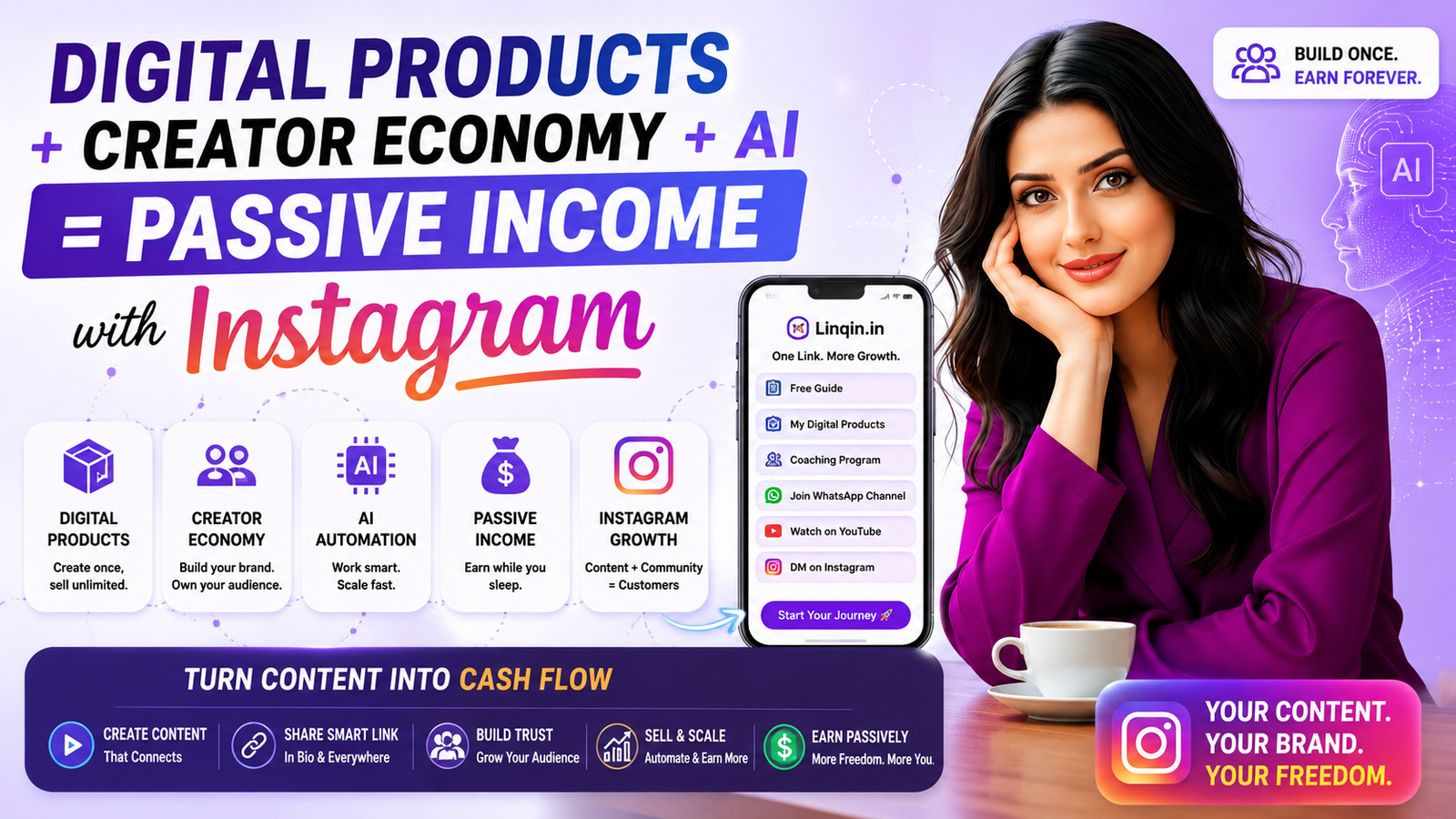
Learn how small creators earn ₹50,000+/month by selling digital products online. Discover profitable ideas, AI tools, marketing strategies, and smart ways to turn your audience into passive income.
How Small Creators Earn ₹50,000+/Month Selling Digital Products
No big following. No fancy studio. Just you, your knowledge, and a few smart digital products — here's the complete playbook.
Every day, thousands of ordinary Indians — teachers, designers, fitness coaches, students, and homemakers — are waking up to a life-changing realisation: their knowledge is worth money. Not in a vague, someday-maybe kind of way. We are talking about consistent, predictable income that often crosses ₹50,000 every single month — without leaving home, without a boss, and without a massive social media following.
This is not hype. This is the new creator economy, and in India, it is just getting started. In this guide, we break down exactly how small creators — people with fewer than 10,000 followers — are building full-time income streams by selling digital products. We will cover what to sell, where to sell, how to price it, and the mindset shifts that separate those who quit in frustration from those who hit ₹50,000+ months consistently.
Why Digital Products Are the Creator's Greatest Weapon
Before we dive into the "how", let us get crystal clear on the "why". You have probably heard of physical products, dropshipping, affiliate marketing, and sponsorship deals. All of those are valid income streams. But none of them match the economics of digital products for a small, solo creator.
Here is what makes digital products extraordinary: you create something once, and you can sell it an infinite number of times. There is no inventory to manage, no shipping to coordinate, no raw material costs to worry about. An e-book you write today can still generate income five years from now. A Notion template you build this weekend can sell 200 copies next month while you sleep.
💡 The magic equation: A digital product priced at ₹999 needs only 50 buyers per month to generate ₹49,950. That is less than 2 sales per day. Even a tiny, engaged audience of 500 people can achieve this.
The other game-changer is profit margins. A physical product might net you 15–25% margin after costs. A digital product routinely delivers 90–95% margin. Every rupee a customer pays is almost entirely yours (minus payment gateway fees and platform commissions).
And the third reason? Digital products are infinitely scalable. Whether you sell 1 copy or 10,000 copies, your workload stays roughly the same. This is not the case with freelancing or coaching, where more income always means more hours.
6 Types of Digital Products Small Creators Are Selling Right Now
Not all digital products are equal. Some take a weekend to build; others take a month. Some are priced at ₹299; others command ₹15,000 or more. Let us look at the six most profitable categories and how real Indian creators are monetising each one.
E-Books & PDF Guides
The classic entry point. A well-structured e-book on a niche problem — e.g., "How to land your first UX job in India" — can sell consistently for months.
Online Courses & Video Modules
Pre-recorded courses on platforms like Teachable or your own site. Once recorded, they generate income 24/7 with zero additional effort per student.
Templates & Swipe Files
Notion dashboards, Canva design packs, Excel trackers, Instagram caption swipe files. These are fast to create and extremely high in perceived value.
Audio & Music Assets
Guided meditations, royalty-free music packs, podcast intro sounds, and language learning audios are all in growing demand from Indian creators.
Presets & Digital Art
Lightroom presets, Photoshop actions, digital illustrations, wallpapers, and stock photos. Especially lucrative for photographers and graphic designers.
Workshops & Live Cohorts
A recorded or live workshop priced ₹999–₹4,999 can clear ₹1 lakh in a single launch weekend with just 100–200 buyers.
💰 What Does a ₹50,000/Month Breakdown Actually Look Like?
Here are four realistic income scenarios for small creators hitting the ₹50,000 milestone:
| Creator Type | Product | Price (₹) | Sales/Month | Monthly Revenue |
|---|---|---|---|---|
| Finance educator | Budgeting Notion Kit | 799 | 65 | ₹51,935 |
| Fitness coach | 12-Week PDF Workout Plan | 999 | 52 | ₹51,948 |
| Instagram designer | Canva Template Pack | 499 | 103 | ₹51,397 |
| Career mentor | Resume + LinkedIn Kit | 1,499 | 35 | ₹52,465 |
| Language teacher | Hindi Grammar E-Book | 599 | 86 | ₹51,514 |
Notice that none of these require a celebrity-level audience. A fitness coach with 3,000 Instagram followers who genuinely connects with her community can convert 1–2% of her audience into buyers every month. That is all it takes.
Finding the Right Niche — The Most Important Decision You Will Ever Make
The number-one reason small creators fail to sell digital products is not a lack of skill or a small following. It is picking the wrong niche. Specifically, they pick niches that are either too broad, too saturated, or have audiences that do not like to spend money.
The ideal niche sits at the intersection of three things: what you know well, what people are desperately searching for, and what people are willing to pay to solve. Notice that "what you are passionate about" is not the primary filter. Passion is important for sustainability, but a market that pays beats passion without buyers every single time.
High-intent problems: Anything related to career growth, income generation, fitness transformation, relationship skills, or competitive exams has a huge paying audience in India.
Underserved language niches: There is enormous demand for quality content in Hindi, Tamil, Telugu, Bengali, and Marathi. Most digital products are in English — own a vernacular niche and you face almost no competition.
Solve a specific transformation: "Lose 10 kg in 12 weeks" sells better than "a guide to fitness". Specificity equals perceived value equals higher conversion.
Validate before you build: Post on Instagram or YouTube with a "Would you buy this?" question. If 10+ strangers say yes, build it. If only your friends reply, rethink the topic.
Look at what you already get asked: The questions your followers, friends, or colleagues keep asking you — that is your niche. You already have the answer; they already want it.
"I had 1,800 Instagram followers when I launched my first Notion productivity kit. I made ₹22,000 in 48 hours because those 1,800 people were the right 1,800 people — not a random mass of followers, but people who had been asking me for exactly that thing."
How to Create Your First Digital Product (Without Overwhelm)
Most aspiring creators spend months — sometimes years — planning their first digital product and never ship it. The antidote is a concept called the Minimum Viable Product (MVP): the smallest, simplest version of your product that still delivers genuine value.
Your first e-book does not need to be 200 pages. A focused, well-designed 25-page guide that solves one specific problem is far more valuable — and far more sellable — than a bloated 200-page book that tries to cover everything. Here is a simple framework to build your first product in one weekend:
Choose ONE specific problem to solve
Not "fitness" — but "how to lose belly fat without going to the gym while working a 9-to-5 job in India." The more specific, the faster people buy.
Outline the solution in 5–7 steps
Every digital product is essentially a series of steps that move the buyer from their current painful state to their desired outcome. Outline those steps first — everything else is detail.
Write, design, or record your content
E-books: use Canva or Google Docs. Templates: use Notion, Figma, or Canva. Courses: use Loom for recording, then upload to Teachable or Gumroad.
Design a compelling cover and product page
People judge digital products by their visual quality. Spend 2–3 hours on a beautiful cover in Canva. A good cover doubles conversion rates. Add a clear headline, 3–5 bullet benefits, and one strong testimonial (even if it is from a beta tester).
Set your price and publish
Do not underprice. ₹499–₹999 is the sweet spot for starter e-books and template packs in India. Anything lower signals low quality; anything higher needs a longer trust runway unless you are already well known.
⚡ Weekend Challenge: Pick a topic you know. Write a 15-page PDF guide. Design it in Canva (free). Upload to Gumroad (free). Share the link with your audience. Done. Your first digital product can be live in 48 hours.
The Best Platforms to Sell Digital Products in India (2024)
You do not need your own website to start selling. Several excellent platforms allow you to list, sell, and deliver digital products with zero technical setup. Here are the top platforms Indian creators are using right now:
Platform Comparison at a Glance
Gumroad is the favourite globally for its simplicity — upload your file, set a price, get a link. Free plan available; it takes 10% per sale on the free tier. Instamojo is the Indian alternative that supports UPI, net banking, and cards, with a simple checkout flow that converts extremely well for the Indian audience. Graphy (formerly Spayee) is built specifically for Indian creators, offering course hosting, community features, and a branded mobile app — all in one platform.
For creators who have some technical comfort and want zero commission on sales, a simple website + Razorpay is the gold standard. You pay a one-time hosting cost and only Razorpay's 2% transaction fee. On ₹50,000 in monthly revenue, that saves you ₹5,000–₹8,000 compared to platform commissions.
Marketing Your Digital Product Without a Big Following
This is where most creators feel stuck. "I only have 2,000 followers — who is going to buy from me?" The answer: more people than you think. But you need to market smart, not just loud.
Strategy 1: Content Marketing (The Long Game)
Every piece of free content you create — a YouTube video, an Instagram carousel, a blog post, a Twitter/X thread — is a permanent salesperson for your digital products. A YouTube video on "How to build a budget in Google Sheets" can drive traffic to your ₹799 budgeting template for years without any additional effort. Create content that answers the exact questions your ideal buyer is Googling.
Strategy 2: Email List (Your Greatest Asset)
Social media platforms can shadowban you, change their algorithm, or disappear entirely. Your email list cannot be taken away. Offer a free "lead magnet" — a mini guide, a checklist, a free template — in exchange for an email address. Even a list of 500 engaged subscribers can generate ₹20,000–₹30,000 per product launch. Build this list from day one.
Strategy 3: Collaborations and Cross-Promotions
Find 3–5 creators in adjacent niches (not direct competitors) and propose a simple deal: you promote their product to your audience; they promote yours to theirs. Both audiences are interested in related topics, so the conversion rates are typically high. This is one of the fastest ways to grow your buyer base without spending a rupee on ads.
Strategy 4: Community-Based Selling
Facebook Groups, Reddit communities, WhatsApp groups, and Telegram channels are goldmines for digital product sellers. Find communities where your ideal buyers hang out. Spend 2–3 weeks genuinely helping members and building authority. Then, when appropriate, share your product. Communities built on trust convert at 3–5x the rate of cold audiences.
Strategy 5: Paid Ads on a Budget
Once you have validated that your product sells organically, you can pour petrol on the fire with paid ads. Meta (Instagram/Facebook) ads work extremely well for digital products in India. Start small — ₹200–₹300 per day — and test multiple ad creatives. A well-optimised ad for a ₹999 e-book can generate ₹3–₹6 for every ₹1 spent. Once you find a winning ad, scale it.
"I grew from ₹8,000 to ₹65,000 per month in four months — not by getting more followers, but by fixing my product page, building an email list of 600 people, and sending one very honest email every week. The money followed the trust."
Pricing Strategy: Why Most Creators Charge Too Little
Underpricing is the single most common mistake first-time digital product creators make. It comes from a place of insecurity: "What if nobody buys at ₹999? Let me price it at ₹199 to be safe." This logic is flawed in two ways.
First, a low price signals low quality. In the digital world, where buyers cannot physically inspect a product before buying, price is a proxy for quality. A ₹199 e-book feels like a quick-and-dirty PDF. A ₹999 e-book feels like a thoughtfully crafted resource. Same content — completely different perception.
Second, you need to sell 5x as many units at ₹199 to match the revenue of a ₹999 price point. That means 5x more marketing effort, 5x more ad spend, and 5x more customer support — for the same income. Charge appropriately for the value you deliver.
Starter products (PDFs, small template packs): ₹499 – ₹999
Mid-tier products (comprehensive courses, large template bundles): ₹1,999 – ₹4,999
Premium products (coaching + course combos, live cohorts): ₹7,999 – ₹19,999
Use tiered pricing: Offer a basic version (₹499), a standard version (₹999), and a premium bundle (₹1,999). Most buyers choose the middle — it is called the "Goldilocks effect" and it boosts average order value by 30–40%.
Your 6-Month Roadmap to ₹50,000/Month
Abstract goals without concrete timelines stay dreams forever. Here is a realistic, step-by-step roadmap that takes an absolute beginner from zero to ₹50,000 per month in six months. It is aggressive but achievable if you treat this like a real business — not a side project you tinker with on weekends.
Month 1: Foundation & Niche Selection
Choose your niche. Audit your skills. Set up your social presence on 1–2 platforms. Start posting free content daily. Build a simple email list using a free Mailchimp or ConvertKit account. Offer a free lead magnet immediately.
Month 2: Build & Launch Your MVP Product
Create your first e-book or template pack in one weekend. Design it well in Canva. List it on Gumroad or Instamojo. Announce it to your existing audience (however small). Aim for ₹5,000–₹10,000 in first-month revenue. Every sale is market validation.
Month 3: Iterate & Build Social Proof
Gather feedback from early buyers. Improve your product. Collect 5–10 testimonials. Update your product page with real results. Your conversion rate will jump by 20–40% with genuine social proof. Revenue target: ₹15,000–₹20,000.
Month 4: Scale Content & Add a Second Product
Double down on the content format that is driving the most traffic. Build a second, complementary product — ideally something your existing buyers ask for. A bundle of both products can command a premium price. Revenue target: ₹25,000–₹35,000.
Month 5: Email Automation & First Paid Ads Test
Set up a simple 5-email welcome sequence that automatically pitches your product to new subscribers. Test a small Meta or Google ad with ₹200/day budget. Identify your best-performing content and repurpose it aggressively. Revenue target: ₹35,000–₹45,000.
Month 6: Launch a Higher-Ticket Offer
Now that you have an audience and proven products, launch a ₹2,999–₹4,999 comprehensive course or live cohort. Even 10–15 sales puts ₹30,000–₹75,000 in your account from a single launch. Combined with passive product sales, ₹50,000+ is now your new baseline. Revenue target: ₹50,000–₹75,000.
The Essential Toolkit (Most of It Is Free)
One of the beautiful things about the digital product business is its near-zero startup cost. Here is everything you need to get started:
Design: Canva (free tier is more than enough for beautiful e-books, covers, social posts, and templates). Figma (free) for more advanced UI/template work.
Email marketing: Mailchimp (free up to 500 contacts), ConvertKit (free up to 1,000 subscribers), or MailerLite. Build your list before you need it.
Payments (India-first): Razorpay or Instamojo for INR payments. Gumroad if you want international buyers. Both support UPI, debit/credit cards, and net banking.
Course recording: Loom (free for up to 25 videos) or OBS Studio (free, open-source). Your smartphone camera is completely fine for most course content.
Analytics: Google Analytics (free) for website tracking. Gumroad and Instamojo both have built-in sales dashboards. Track your conversion rate and average order value every week.
🛠️ Total startup cost for your first digital product business: Possibly ₹0. You can use Canva Free, Gumroad Free, Mailchimp Free, and Loom Free. Your only investment is time — and that is the best kind of investment.
The Mindset Shifts That Separate ₹5K Creators from ₹50K Creators
Strategy without the right mindset is a recipe for frustration. Here are the mental shifts that the most successful small creators have made — the ones who now consistently earn ₹50,000+ per month from products they built once.
From "I don't know enough" to "I know more than a beginner needs"
You do not need to be the world's leading expert. You just need to be three steps ahead of your ideal buyer. A college student who learned to invest in mutual funds can teach someone who has never opened a trading account. That teacher-student gap is exactly the value gap you monetise.
From "I need to wait until it's perfect" to "done is better than perfect"
Perfectionism is procrastination in a costume. Your first product will not be perfect. It will have typos, imperfect design, and coverage gaps. Ship it anyway. Real buyers give real feedback. You improve the product. Version 2 is better. Version 3 is great. None of this happens until you ship Version 1.
From "selling feels icky" to "selling is serving"
Many Indian creators feel deeply uncomfortable about charging for their knowledge. Reframe it: if you genuinely have a solution to someone's painful problem, not selling it to them is doing them a disservice. Every ₹999 someone pays you is an investment in their transformation. That is not exploitation — that is value exchange.
From "I need more followers" to "I need more trust"
Stop obsessing over follower counts. A creator with 800 deeply trusting followers will outsell a creator with 80,000 passive followers every single time. Build trust through consistency, honesty, and genuine helpfulness. Revenue follows trust, not numbers.
5 Mistakes That Kill Your Digital Product Sales
Avoid these five mistakes and you will be months ahead of most creators:
Building before validating: Spending three months on a course nobody asked for. Always validate demand before you build. Post about the idea, run a poll, or presell with a waitlist first.
Launching once and forgetting: Most creators announce their product once, get a few sales, and then never mention it again. Your product should be promoted in some form every single week — through content, email, or social posts.
No email list: Social media can vanish overnight. An email list is your safety net and your most powerful sales channel. Start building it on Day 1, not Day 100.
Ignoring the product page: A great product with a bad sales page will not sell. Invest time in writing clear, benefit-focused copy that answers the buyer's key question: "What's in it for me?"
Quitting too early: Most creators quit just before momentum kicks in. The first month is always slow. The second is a little better. Month four is when things start to compound. The creators who reach ₹50,000 are simply the ones who did not quit in Month 2.
3 Real Indian Creator Stories That Prove This Works
Nothing is more convincing than real examples. Here are three composite profiles based on real creator patterns in India — small creators who built real income from digital products.
Story 1: The Homemaker Who Built a ₹60K/Month Recipe Business
Kavitha from Chennai had been sharing Tamil recipes on Instagram for two years. She had 4,200 followers — not huge. But every week, her DMs were flooded with the same questions: "What are the measurements?", "Can you share a diet plan?" She packaged those recipes into a ₹499 Tamil-language recipe and diet plan PDF. Within 30 days, 127 people had purchased. That is ₹63,373. She has since created three more products and now earns ₹60,000–₹80,000 every month from her phone, around her family's schedule.
Story 2: The Teacher Who Turned WhatsApp Voice Notes into a ₹55K Course
Amit, a 32-year-old government schoolteacher in Rajasthan, used to send WhatsApp voice notes to students who missed class. He organised those notes into a structured audio course for Class 10 Hindi grammar. Price: ₹599. He shared the link in three local parent WhatsApp groups. Word spread. In two months, he had sold 92 copies. Now he creates one new audio module every month and consistently earns ₹50,000–₹55,000 — more than his teaching salary.
Story 3: The Graphic Designer Who Sells Canva Templates
Neha from Hyderabad had 1,100 Instagram followers and a full-time job. She created a pack of 30 Instagram post templates for small business owners — clean, minimal, easily editable. Price: ₹799. She showed the before-and-after of a client's Instagram feed using her templates. The post went modestly viral in small business owner groups. She made ₹47,200 in Month 1. She has now built a library of 12 template packs priced between ₹499 and ₹2,499, earning ₹1.1 lakh per month — all while keeping her job.
The Opportunity Is Here — And It Is Not Going Away
We are living through the most extraordinary moment in the history of human knowledge sharing. For the first time, a 22-year-old from a small town in Bihar can sell her expertise to someone in Mumbai, Singapore, and Houston — all at once, all automatically, while she sleeps.
The creator economy in India is not some Western import. It is a homegrown revolution, fuelled by affordable smartphones, cheap data, and an entire generation that has normalised learning from online creators. The infrastructure is here. The audience is here. The demand is here.
What is still in short supply is quality. Most digital products are either overpriced and underwhelming, or underpriced and undiscovered. The gap between what buyers want and what creators are offering is your opportunity.
You do not need 100,000 followers. You do not need a professional recording studio. You do not need a fancy website or a big marketing budget. You need one good product, one small genuine audience, and the courage to put your knowledge out into the world and say: "I made this. It will help you. Here is the price."
₹50,000 per month is not a fantasy number. It is the arithmetic of small actions compounding over time. Start this weekend. Build something useful. Price it fairly. Tell people about it. Do it again. That is the entire playbook.
🎯 Your action item for today: Write down one skill or piece of knowledge you have that someone else would pay to learn. Just one. That is your first digital product idea. The rest of the journey begins from there.
