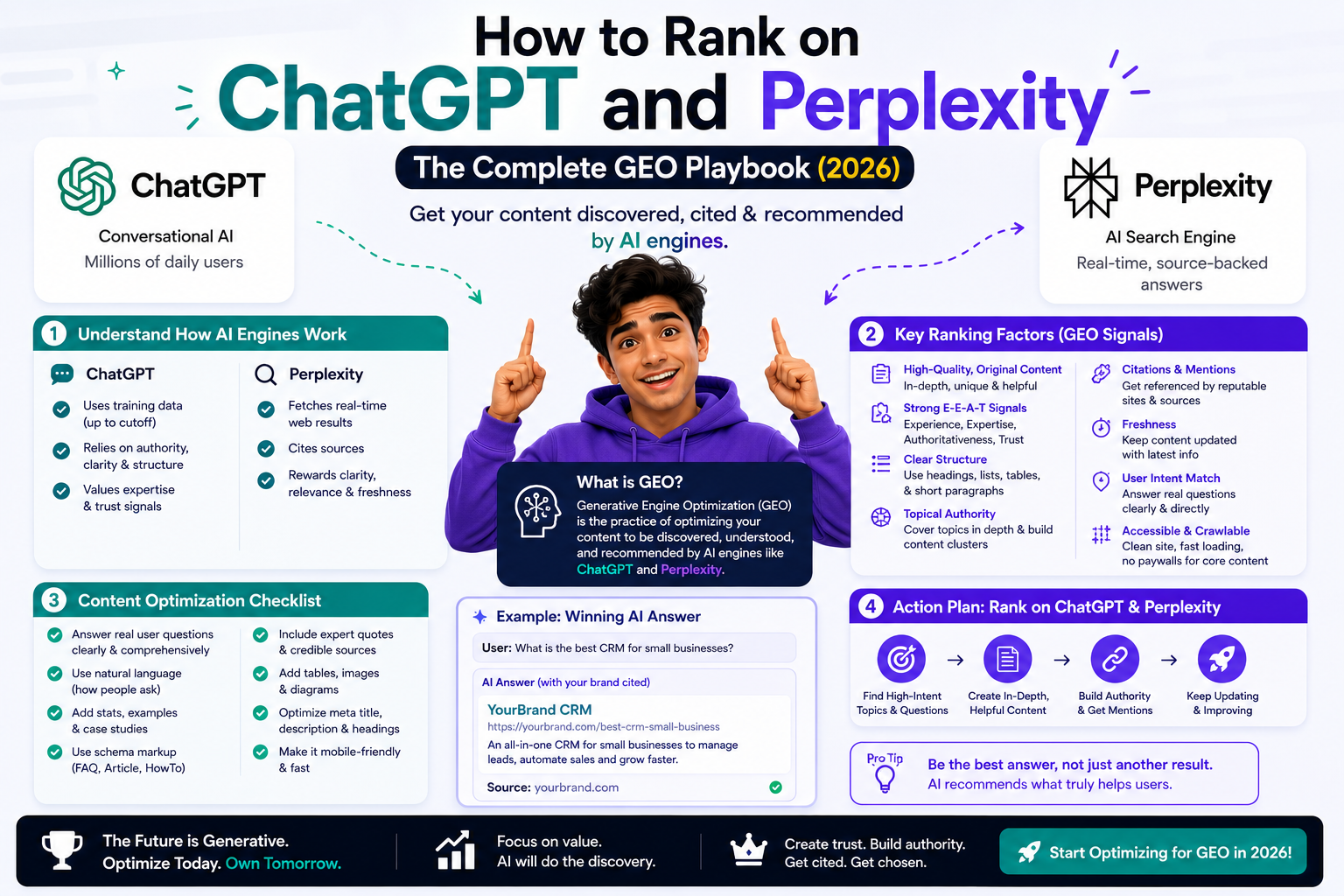
How to get your brand cited by ChatGPT, Perplexity, and Gemini — 10 proven GEO tactics based on Princeton and Georgia Tech research. The complete AI ranking playbook for creators in 2026.
How to Rank on
ChatGPT
& Perplexity
The complete GEO playbook for creators and businesses
Millions of people now ask ChatGPT, Perplexity, and Gemini what to buy, which tools to use, and who to hire. Getting your brand mentioned in those AI answers is the new SEO — and the tactics are specific, learnable, and already working for creators who know them.
your brand needs to be in that answer.
Here is a scenario playing out millions of times a day right now. A creator opens ChatGPT and types: "What is the best link-in-bio tool for Instagram creators in India?" The AI generates a confident, specific answer — naming two or three platforms, explaining their differences, recommending one. The user follows that recommendation. They never open Google. They never see a search results page.
If your brand is in that answer, you win a customer who arrived with zero friction and maximum intent. If your brand is not in that answer, you don't exist for that user — regardless of how well you rank on Google, how many Instagram followers you have, or how good your product actually is.
This is the new search reality. And unlike traditional SEO, which took months to learn and years to master, the tactics that get you cited by AI engines are learnable in an afternoon and implementable this week. Here is the complete playbook.
The MechanismHow ChatGPT and Perplexity Decide What to Recommend
Before diving into tactics, understanding how AI engines select content to cite is the foundation of everything. ChatGPT and Perplexity work in fundamentally different ways — and both matter.
How ChatGPT decides (training data model)
ChatGPT's knowledge comes from training data — vast amounts of web content processed before a cutoff date. When it recommends a brand or tool, it's drawing on how frequently and authoritatively that brand appeared across its training corpus. Brands mentioned consistently across many high-quality sources — blog posts, forum discussions, YouTube descriptions, news articles, product reviews — are more likely to be cited than brands with a thin web footprint. GEO for ChatGPT is fundamentally about web presence breadth and brand authority.
How Perplexity decides (live web retrieval)
Perplexity works differently — it actively crawls the live web in real time when answering a query, retrieves the most relevant current pages, and synthesises an answer from what it finds. GEO for Perplexity is therefore more like traditional SEO: your pages need to be crawlable, well-structured, and directly answer the question being asked. Structured data, clear entity definitions, FAQ sections, and specific factual content are key.
How Google AI Overviews decides
Google AI Overviews uses a hybrid — it draws on Google's index of ranked content plus real-time retrieval. Content that already ranks well in Google's index has a higher chance of appearing in AI Overviews. This makes traditional SEO and GEO more deeply intertwined for Google than for the other engines.
AI engines are trained to find the most authoritative, clearly-stated, factually specific answer to a question. They are not trained to find the most keyword-optimised page. Write for a knowledgeable human reader who needs a specific, reliable answer — and AI engines will find your content naturally.
The Playbook10 Proven Tactics to Get Cited by AI Engines
AI engines retrieve and synthesise content to answer a user's question. When scanning your page, they prioritise content that delivers the answer immediately — in the opening sentence or paragraph — over content that buries the answer after three paragraphs of preamble. Every piece of content should open with the direct answer to the question it addresses.
This applies to blog post introductions, FAQ answers, product descriptions, and your about page. The headline promises an answer. The first sentence delivers it.
Research from Princeton University (2024) found that content containing specific statistics was cited by AI engines at significantly higher rates than content with vague claims. AI engines are trained to favour verifiable, specific information over generic statements — because specific data signals genuine expertise and allows for fact-checking.
Replace every vague phrase with a specific one. Conduct original research on your audience. Cite reputable external studies. Your own platform data — transaction counts, conversion rates, user numbers — is particularly valuable because it can't be found anywhere else.
FAQ sections are the most directly AI-compatible content format that exists. They mirror exactly how AI engines respond to user queries — a question followed by a direct, complete answer. Google AI Overviews, Perplexity, and Bing Copilot all actively extract FAQ-formatted content for use in their generated answers.
Add 6–10 genuine questions to every blog post and key page. Use FAQ schema markup (JSON-LD) to make extraction explicit. Write answers that stand alone as complete responses — a single FAQ answer should be usable as an AI citation without any surrounding context.
For ChatGPT and other training-data-based models, your brand needs to appear consistently across many high-quality external sources. The AI encountered your brand during training — or it didn't. Building external brand presence is the GEO equivalent of link building for traditional SEO.
Target: guest posts on authoritative blogs in your niche, podcast mentions, YouTube video descriptions and scripts that name your platform, Reddit discussions where your tool gets mentioned organically, Product Hunt listings, tool roundups in newsletters, journalist features, and Quora answers. Every external mention is a training signal.
Comparison queries are among the most frequent questions AI engines receive from users: "What is better, A or B?", "What is the best tool for X?", "Linktree vs Linqin — which should I use?" Creating content that directly, thoroughly, and honestly answers these comparison questions puts your content in prime position for AI citation when these queries are asked.
Structure your comparison content with a clear verdict, specific feature comparisons, honest acknowledgement of where your brand isn't the best choice, and direct answers to the most common questions in the FAQ. AI engines favour balanced, expert comparisons over promotional content.
AI models are trained to extract citable, reliable facts. Heavily hedged language — "may offer," "could potentially," "in some cases," "it's possible that" — reads to an AI model as uncertain or unreliable. Definitive, confident statements are more likely to be cited because they can function as standalone facts.
This doesn't mean being inaccurate. It means being specific enough that you don't need to hedge. "Linqin.in charges 0% platform transaction fee" is definitive because it's a verifiable fact. "Linqin.in may offer competitive pricing" hedges because it's vague.
Schema markup is machine-readable metadata that explicitly tells crawlers what your content is, who created it, what questions it answers, and how it's structured. For Perplexity and Google AI Overviews, schema markup is a direct signal for extraction and citation. The most valuable schemas for GEO are: FAQPage, Article, HowTo, Product, and Organization.
Your Organization schema should include your brand name, URL, description, founding date, and social media profiles — this is how AI engines build a consistent, factual entity understanding of your brand. Your FAQPage schema on every blog post is directly extracted by Google AI Overviews for featured placement.
"What is X" queries are among the most common questions asked to AI engines. If you publish the clearest, most complete, most factually precise explainer for a concept in your niche, AI engines will use it as their source when answering those questions. For Linqin.in, that means owning definitions like "What is GEO SEO," "What is a smart bio link page," and "What is Instagram comment automation."
For your brand specifically: what concepts, tools, or categories do you want to be the definitive source for? Publish the best explanation that exists on the internet for each of those. Write it as if you were the Wikipedia entry — comprehensive, factual, clearly structured, and unambiguously authoritative.
When a well-known marketing blog publishes "10 Best Link-in-Bio Tools for Creators" and includes Linqin.in — that article becomes a training data source for AI models. When multiple such articles from different reputable sources include the same brand, AI models develop a confident association: "Linqin.in is a well-regarded link-in-bio tool for creators." This directly influences citation frequency.
Prioritise: Product Hunt launches, G2/Capterra/Trustpilot listings, inclusion in respected newsletter roundups, features in marketing-focused publications (HubSpot Blog, Social Media Examiner, Buffer Blog), and app store listings. Each placement is a persistent training signal.
Topical authority — covering every meaningful angle of a specific subject — is recognised by both Google and AI engines as a signal of genuine expertise. A single blog post is a data point. Fifteen deeply interlinked posts on your niche create an authority cluster that signals you are the source on that topic.
For example, this Linqin.in blog cluster on AI search: "What is GEO SEO," "SEO vs GEO," "SEO vs AI Search 2026," "Is SEO Dead 2026," and "How to Rank on ChatGPT and Perplexity" — all interlinked, all factually consistent, all citing each other. AI engines encountering this cluster during retrieval or training develop strong authority association for Linqin.in on AI search topics.
"The question isn't 'how do I trick ChatGPT into mentioning me?' The question is: if ChatGPT wanted to give the most accurate, helpful answer about my niche — would my content be the best source available? Build toward that, and the citations follow."Linqin GEO Research · 2026
Engine by EngineHow Each AI Engine Works — and What to Prioritise
| GEO Factor | 💬 ChatGPT | 🔍 Perplexity | ✨ Gemini + AI Overviews |
|---|---|---|---|
| How it finds content | Training data (+ web search) | Live web crawl | Google index + live crawl |
| Brand mentions across web | ✓ Critical | Helpful | Helpful |
| FAQ schema markup | Moderate benefit | ✓ High impact | ✓ Critical |
| Specific data + stats | ✓ Critical | ✓ Critical | ✓ Critical |
| Comparison content | ✓ Frequently cited | ✓ Frequently cited | ✓ Frequently cited |
| Content freshness | Less critical (training cutoff) | ✓ Very important | ✓ Important |
| Traditional SEO signals | Indirect benefit | ✓ Strong overlap | ✓ High overlap |
| Product Hunt / directories | ✓ Training signal | Moderate | Moderate |
| Topical content cluster | ✓ High impact | ✓ High impact | ✓ High impact |
| Best starting tactic | Build external brand mentions | Add FAQ schema + direct answers | FAQ schema + Google ranking |
FAQFrequently Asked Questions
Build the content that gets
cited by AI — free on Linqin.
Built-in SEO + GEO blog · AI-crawlable pages · FAQ schema ready · Free forever
