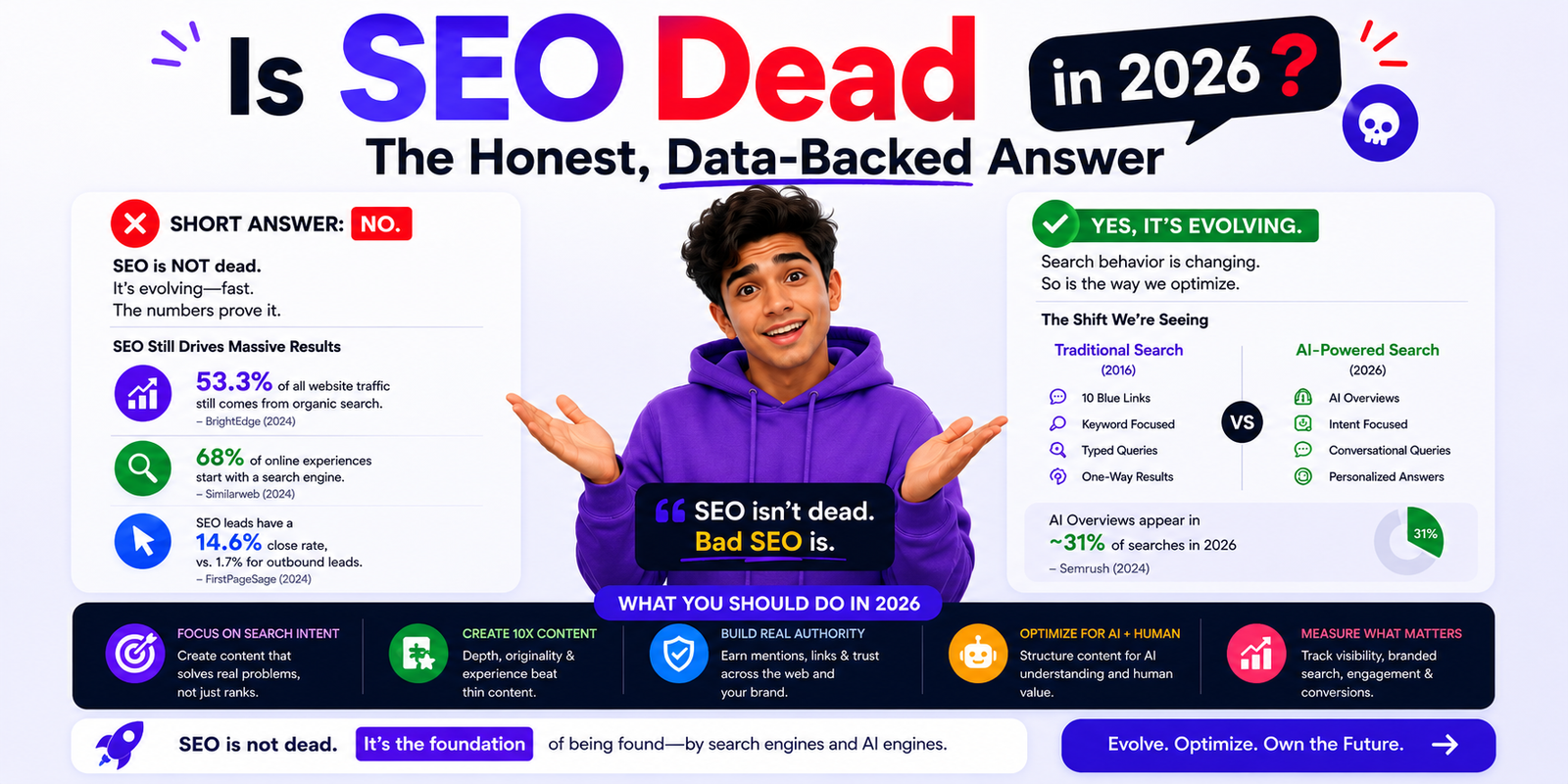
Is SEO dead in 2026? The honest answer with data — Google still processes 8.5B searches/day. What's actually declining, what still works, and what creators must do now.
Is SEO DEAD No. But it's not what it was.
Every few years, someone declares SEO dead. In 2026, with AI search handling billions of queries, the question is more serious than ever. Here's the honest, data-backed answer — and what creators and businesses actually need to do about it.
But here's what the data says about
what changed
8.5B queries/day
informational queries
update for AI era
The short answer is no — SEO is not dead in 2026. Google still processes approximately 8.5 billion searches per day. Organic search remains the single largest source of website traffic globally, ahead of social media, paid advertising, email, and direct traffic. Businesses and creators who rank well on Google still generate consistent, high-intent, free traffic every day.
But here's what's true: certain SEO tactics that worked well in 2020 are significantly less effective in 2026. AI search has changed user behaviour in specific, measurable ways. And creators who are still running the exact same playbook from five years ago are leaving traffic on the table — or worse, watching traffic decline without understanding why.
This post gives you the complete, honest picture: what's still working, what has declined, what has evolved, and exactly what to do about it.
The ConcernWhy So Many People Are Asking "Is SEO Dead?"
The "SEO is dead" conversation is louder in 2026 than it's ever been — and for understandable reasons. Several real, observable changes have happened simultaneously:
- Google AI Overviews now answer questions directly on the search results page — meaning for many informational queries, users never scroll to the ranked links at all
- ChatGPT, Perplexity, and Gemini are handling billions of queries per month that used to go to Google — a genuine shift in where people start their searches
- Publishers are reporting traffic declines — many content sites that relied on informational blog traffic have seen 20–50% drops in organic clicks since 2023
- Zero-click searches — searches where Google answers the question directly in the SERP — now account for an estimated 58% of all Google searches in the US
- AI-generated content flooding search — the quality bar for ranking has risen as Google actively works to filter AI-spam from results
Traffic to thin informational content — "what is X" posts, basic how-to guides, simple definition articles — is genuinely declining as AI engines answer these queries without sending users to websites. If your entire content strategy is built on informational blog posts with no genuine depth or expertise, you have a real problem that SEO alone won't solve.
The EvidenceWhy SEO is Definitively Not Dead
For every piece of evidence suggesting SEO is declining, there's stronger evidence that it remains essential and effective — for the right content types and the right approach.
SEO is not dead. Bad SEO is dead. Generic informational posts, keyword-stuffed content, and thin articles designed for ranking rather than genuinely helping readers — this is what's declining. Well-researched, expert, structured content continues to rank well and drive high-intent traffic.
Old vs NewWhat Changed — Old SEO vs 2026 SEO
The tactics themselves have evolved significantly. Here's the honest side-by-side of what worked in 2019–2021 versus what drives results in 2026:
ScoredEvery Major SEO Tactic — Dead, Alive, or Evolved?
Keyword Research and Targeting
Finding what your audience searches and aligning content to those queries
Building Quality Backlinks
Earning links from authoritative, relevant websites in your niche
Technical SEO (page speed, Core Web Vitals, structured data)
Ensuring your site is crawlable, fast, and technically correct
Local SEO and Google Business Profile
Optimising for location-based searches and Google Maps visibility
E-E-A-T: Expert, First-Hand Content
Demonstrating genuine expertise and real-world experience in content
FAQ Sections with Schema Markup
Structured Q&A content that earns featured snippets and AI citations
Thin Informational Blog Posts ("What is X")
Generic definition and overview content without real depth or expertise
AI-Generated Bulk Content at Scale
Mass-producing articles using AI without human expertise or editing
Low-Quality Link Schemes and PBNs
Buying backlinks or using private blog networks for manipulation
GEO — Generative Engine Optimisation
Optimising content to be cited by ChatGPT, Perplexity, Gemini, AI Overviews
Building Owned Audiences (Email + WhatsApp)
Capturing contacts directly — algorithm-independent traffic channel
Keyword Density Optimisation
Stuffing target keywords at specific percentages throughout content
"SEO dies a headline death every two years. In reality, it just raises the bar. The websites that were ranking in 2015 on thin content deserve to lose that traffic. The ones ranking in 2026 earned it."Linqin Search Analysis · 2026
Who's AffectedIs Your Content Strategy at Risk?
Not all creators and businesses are equally affected by the shift. Here's an honest risk assessment by content type:
General informational blog (what/how/why posts)
Primary risk zone — AI Overviews directly answers these queries without a click
Commercial comparison content (X vs Y, Best X for Y)
Moderate — AI competes here but Google still drives buying intent clicks
Local business SEO (restaurant, salon, service)
Minimal risk — local search remains Google-dominated with minimal AI disruption
Expert niche content with original research + data
Low risk — Google rewards this and AI engines cite it, dual benefit
E-commerce product pages (transactional)
Minimal risk — transactional queries still flow through Google Shopping and organic
Action PlanWhat Creators Should Actually Do in 2026
Given everything above, here's the practical action plan for 2026 — covering both protecting your SEO traffic and building resilience against AI search disruption:
- Audit your traffic by content type: Open Google Search Console. Which of your pages are informational (high AI risk) vs commercial/local (lower risk)? Prioritise improving or replacing the informational posts that are declining.
- Double down on genuine expertise: Publish fewer posts, but deeper ones. Include original case studies, real examples, proprietary data, and first-hand experience. This is what both Google and AI engines reward in 2026.
- Add FAQ sections to every existing post: With FAQ schema markup, these win Google featured snippets AND get cited by AI Overviews and Perplexity. The single highest-ROI update you can make to existing content.
- Build commercial content around your niche: "Best X for Y" and "X vs Y" posts remain strong on Google for buying-intent queries. These are less disrupted by AI search than pure informational content.
- Build an owned audience — your algorithm insurance policy: An email list and WhatsApp broadcast list are completely immune to SEO algorithm changes. Use Linqin.in's free lead capture to collect email and WhatsApp from every website and Instagram visitor.
- Add GEO to your SEO practice: GEO (Generative Engine Optimisation) — optimising for AI search citations — now complements traditional SEO. Write specific, citable facts. Build brand mentions across multiple platforms. Target question-format content.
- Invest in local SEO if you're a local business: This is one of the most disruption-resistant SEO strategies available. Google Business Profile optimisation, local citations, and review generation all remain highly effective.
The most search-proof asset a creator can build is an owned audience — people who've given you their email and WhatsApp number directly. No algorithm change, Google update, or AI search disruption can take that away. Linqin.in's free lead capture funnel automatically collects email and WhatsApp from every Instagram and blog visitor — building your owned audience in the background while you focus on content.
ReferenceSEO in 2026 — Complete Status Reference
| SEO Area | 2026 Status | Key Change Since 2022 |
|---|---|---|
| Keyword targeting | ✓ Essential | Intent-matching more important than density |
| Quality backlinks | ✓ Essential | Editorial quality matters more; bought links penalised harder |
| Technical SEO | ✓ Essential | Core Web Vitals scoring harder; AI crawlers added |
| E-E-A-T (expertise) | ✓ More critical | Google's primary quality signal for content |
| Local SEO | ✓ Stronger | Minimal AI disruption; Google Maps still dominant |
| Schema markup | ✓ More valuable | AI Overviews extract FAQ schema directly |
| Informational content | ⚠ Evolve | Needs depth + expertise; thin posts losing traffic |
| Commercial/comparison | ✓ Still strong | Moderate AI competition; buying intent still Google |
| AI-generated bulk content | ✗ Penalised | Google actively demotes; quality bar has risen |
| Keyword stuffing | ✗ Dead | Was already declining; now actively harmful |
| GEO for AI search | 🆕 Add now | New discipline — AI search citation optimisation |
| Owned audience building | ✓ Critical | Algorithm insurance; email + WhatsApp list essential |
FAQFrequently Asked Questions
SEO traffic + owned audience —
build both, starting free.
Linqin.in blog for SEO content · Lead capture for owned audience · AI-indexable pages · Free forever plan.
