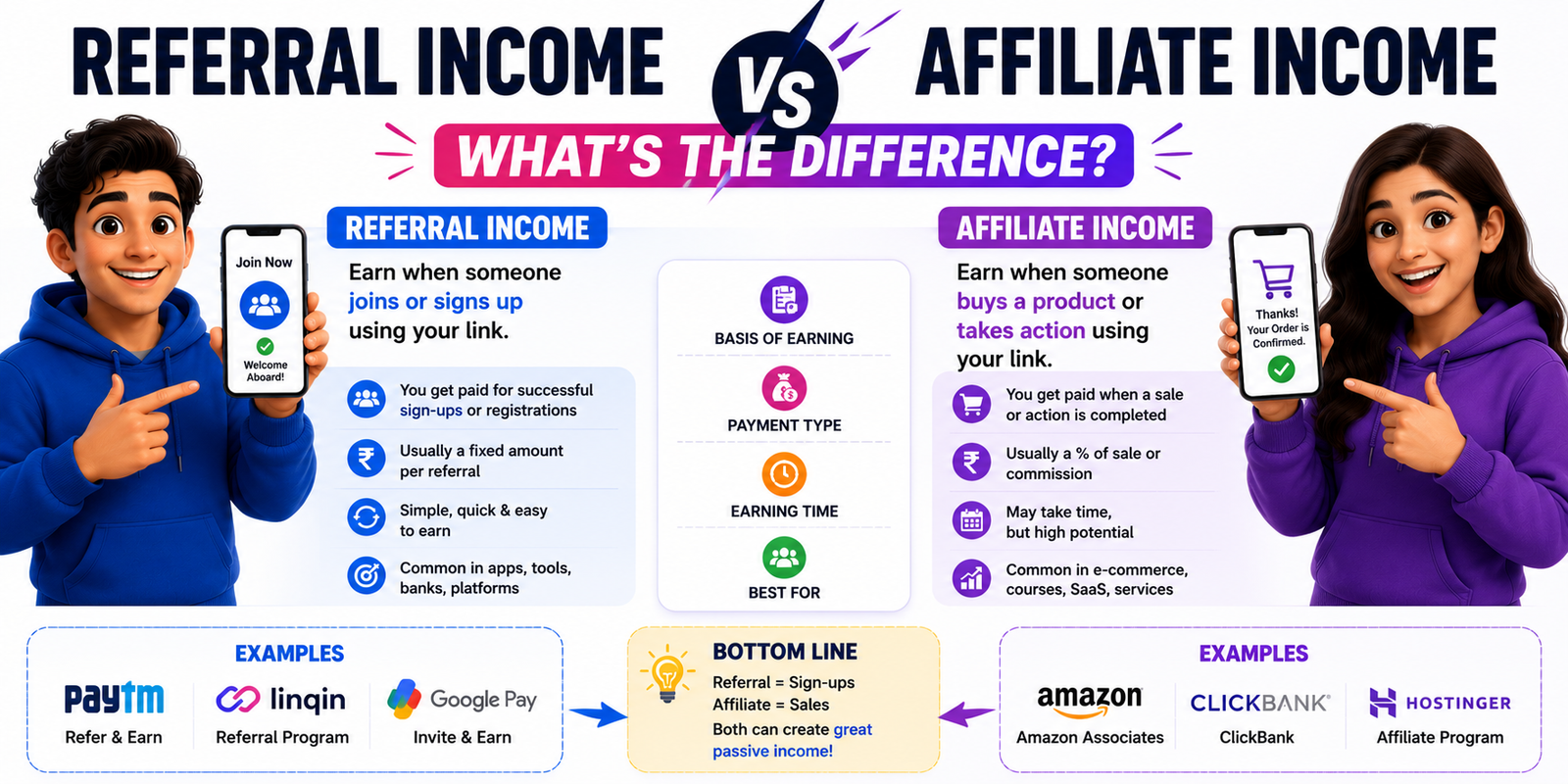
Referral income vs affiliate income explained — how each pays out, one-time vs recurring rewards, what you promote, and which model fits creators best.
Referral Income vs Affiliate Income — What’s the Difference?
People use “referral income” and “affiliate income” like they mean the same thing. They’re cousins, not twins. Both pay you for bringing in customers through a link — but how they pay, what you promote, and how long the money lasts are genuinely different.
If you’re a creator trying to choose where to put your energy, understanding the difference helps you pick the right model — or smartly combine both. Let’s break it down clearly.
The simple definitions
Affiliate income is when you promote someone else’s product and earn a commission each time someone buys through your link. You’re a salesperson for a product you may or may not personally use. The payout is usually tied to a sale.
Referral income is when you invite people to a service or tool you already use, and you earn a reward when they sign up and stay active. You’re recommending an experience you’re part of. The payout is often tied to sign-ups and ongoing usage — frequently recurring.
Side-by-side at a glance
The key differences, explained
Affiliate income needs a purchase — no sale, no commission. Referral income usually needs a sign-up plus activity, which is often easier to achieve, especially for free tools.
Affiliate payouts are typically one-and-done per sale. Referral rewards are frequently recurring — a single referral can keep paying for months while that user stays active.
Affiliates can promote almost anything, even products they’ve never touched. Referrals work best when you genuinely use the tool — which makes them feel more authentic to your audience.
Affiliate income can scale fast with big launches and large catalogs. Referral income is usually more stable and compounding — slower to spike, but steadier over time.
In one line: Affiliate income pays you to sell a product. Referral income pays you to share an experience you’re already living.
Which one should you choose?
Lean toward affiliate income if your content naturally reviews products, compares options, or helps people decide what to buy — think tech, beauty, gadgets, or shopping niches. The bigger the catalog you can recommend, the higher your earning potential.
Lean toward referral income if you regularly share your workflow, tools, and processes — creators, freelancers, and educators do this brilliantly. Because the rewards are recurring and tied to tools you actually use, it builds a calmer, more predictable income over time. The honest answer for most creators, though, is simple: do both.
Why smart creators use both together
The two models cover each other’s weak spots. Affiliate income gives you bursts of higher earnings around launches and sales, while referral income provides the steady, recurring base that keeps flowing between those spikes. One is the sprint, the other is the marathon.
In practice, a single piece of content can carry both. A “my creator setup” video might include affiliate links to the gadgets you bought and referral links to the tools you use daily. You record once, and two different income models work from the same upload. A clean link hub (like Linqin) makes this effortless — keeping all your affiliate and referral links organised behind one link, with tracking that shows you what’s actually working.
Frequently asked questions
No. They overlap, but affiliate pays per sale and is usually one-time, while referral pays for active sign-ups and is often recurring.
It depends. Affiliate can scale higher with big sales, while referral builds steadier, compounding income. Many creators earn most by combining both.
Referral programs are often easier to start, since rewarding a free sign-up is simpler than convincing someone to make a purchase.
Absolutely. They complement each other, and a single link hub lets you manage all your affiliate and referral links in one place.
Run both from one link
Stop choosing between affiliate and referral income. Organise both behind a single, trackable link hub and let every piece of content earn from both.
