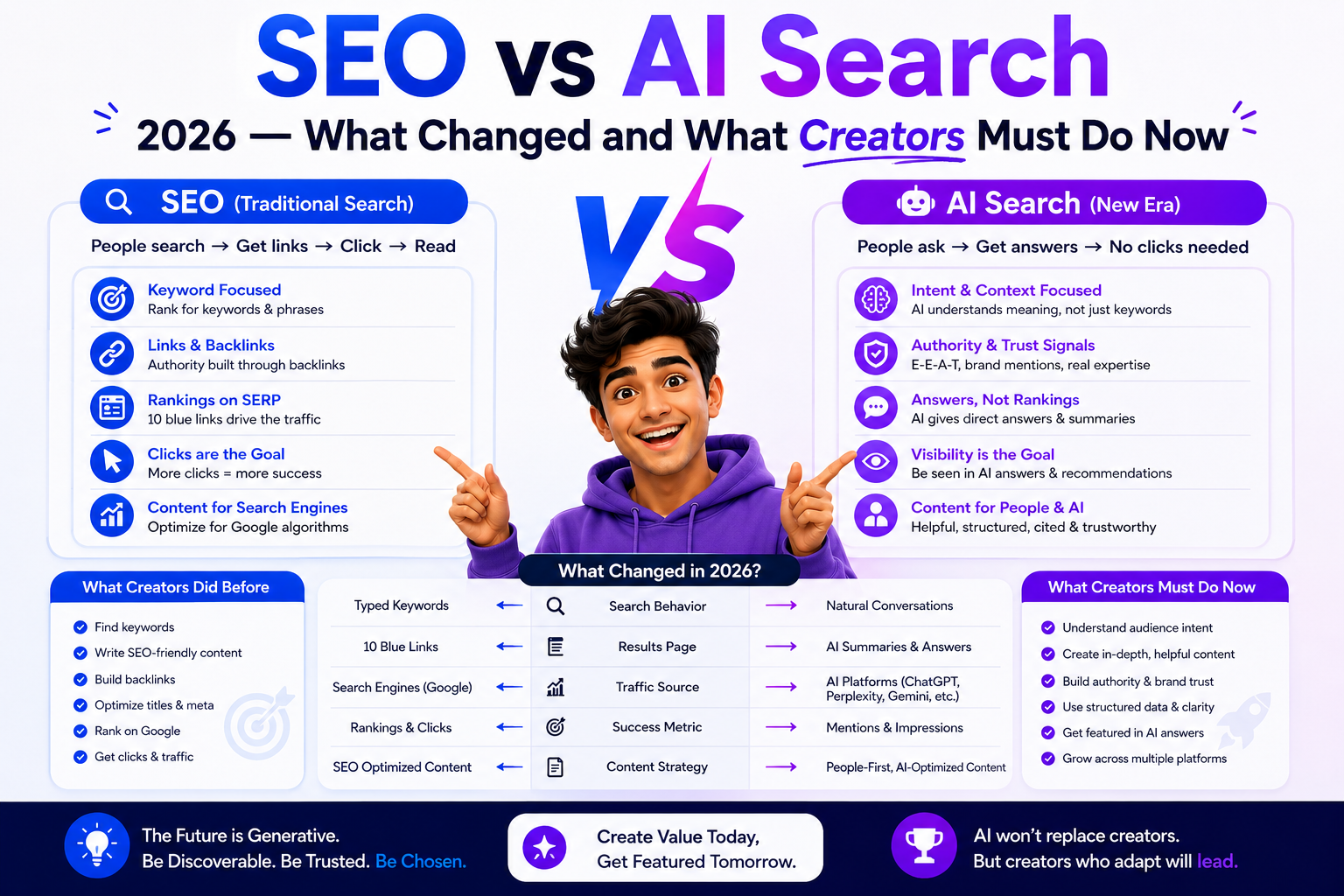
SEO vs AI search in 2026 — what actually changed, which queries shifted to AI, what's declining vs still working, and the 7-step action plan for creators to win on both channels. Data-backed analysis.
SEO
vs AI Search
What changed in 2026 — and what creators
must do differently right now
AI search engines are handling more queries every month. Google's organic click-throughs are declining. Traditional SEO isn't dead — but the rules have changed in ways most creators haven't caught up with yet. Here's the full picture.
In January 2023, most creators were still entirely focused on Google. Rankings, backlinks, keyword density, Core Web Vitals — the SEO playbook that had worked for 20 years was still the only game in town. Then ChatGPT hit 100 million users in two months. Google launched AI Overviews. Perplexity reached 100 million monthly users. Gemini integrated into every Google product.
By May 2026, the search landscape looks fundamentally different. AI search engines now handle an estimated 3+ billion queries per month globally — and a growing portion of those queries never result in a click to any website. The implications for creators, bloggers, and small businesses who depend on search traffic are significant.
This isn't a panic piece. SEO is not dead. But the playbook has evolved — and creators who understand both traditional SEO and AI search (and how they interact) will have a structural advantage over those still optimising purely for Google rankings from 2019.
What ChangedThe Search Landscape in 2026 vs 2022
Understanding what has actually shifted — versus what remains stable — is the starting point for any rational response to AI search. Let's separate fact from hype.
The shift is real — but it's uneven. Not all query types are affected equally. Understanding which of your content types are most exposed to AI search disruption versus which remain safely in Google's traditional results is the most valuable insight a creator can have right now.
Query TypesWhich Searches Are Going to AI — and Which Stay on Google
The single most important framework for creators in 2026: different query types respond very differently to AI search. Here's how to think about your content portfolio:
If your content strategy is primarily informational blog posts ("what is X", "how to do Y") — you face the highest AI search disruption risk. AI Overviews and ChatGPT now answer these queries directly. If your strategy includes commercial content (tool comparisons, product reviews, buying guides) — you're in the mixed zone where both SEO and AI search matter. Local and transactional content remains largely safe in traditional search.
Status ReportWhat's Dead, What Still Works, What's Evolved
"The creators who panic about AI search are the same ones who panicked about every Google algorithm update. The creators who adapt — adding GEO tactics to their existing SEO work — are the ones who grow through the transition."Linqin Creator Research · 2026
What WorksTactics That Win on Both SEO and AI Search
The good news — and it's genuinely good — is that high-quality content serves both traditional SEO and AI search. The same habits that make content rank on Google also make it citable by AI engines. Here's what wins on both:
Full TableSEO vs AI Search — Every Dimension Compared
| Dimension | 🔍 Traditional SEO | 🤖 AI Search (GEO) |
|---|---|---|
| Primary engines | Google, Bing, DuckDuckGo | ChatGPT, Gemini, Perplexity, Claude |
| Success = | Page 1 ranking + click-through | Brand cited in AI answer |
| Backlinks still important? | ✓ Critical | Helpful, not primary |
| Keywords still matter? | ✓ Essential | For web-access AI, yes |
| Content length | Long-form tends to rank better | Concise, direct answers rank better |
| Technical SEO | ✓ Page speed, Core Web Vitals | Clean HTML structure matters |
| Schema markup | ✓ Strong ranking signal | ✓ Key AI extraction signal |
| FAQ sections | ✓ Featured snippets, PAA | ✓ Top AI citation format |
| Expert voice (E-E-A-T) | ✓ Google Quality signal | ✓ AI citation preference |
| Original data/statistics | ✓ Earns backlinks | ✓ High AI citation rate |
| Time to results | 3–12 months typical | Can appear in AI answers faster |
| Traffic type | Direct clicks to your page | Brand visibility, sometimes no click |
| Local search | ✓ Still Google-dominant | AI maps growing but small |
| Declining for? | Simple informational queries | Not applicable — it's growing |
Action PlanYour 2026 Search Strategy — 7 Steps to Execute Now
Here's the concrete action plan for creators who want to win on both traditional SEO and AI search in 2026:
Audit Your Content Portfolio by Query Type
Open Google Search Console. Look at your top-traffic pages. Classify each as informational, commercial, or navigational. Informational content (especially thin posts) is most at risk from AI search disruption — prioritise strengthening it or replacing it with deeper expert content that AI engines are more likely to cite.
Add FAQ Sections to Every Existing Blog Post
This single tactic improves Google featured snippets (SEO), Google AI Overviews citations (GEO), and Perplexity citations simultaneously. Write 5–8 genuine questions your audience asks, with direct, specific answers. Add FAQ schema markup. Start with your top-10 traffic pages.
Build Your Email and WhatsApp List — Now
This is the most search-algorithm-proof move available. An email list and WhatsApp broadcast list are owned channels that no Google update or AI search shift can take away. Use Linqin.in's lead capture funnel to capture email and WhatsApp from every Instagram and web visitor — building a direct communication channel to your audience that's independent of any search engine.
Publish Comparison and "Best X" Content
Commercial intent content performs in both channels: Google still ranks comparison and best-of content high for buying-intent searches, AND AI engines are frequently asked these comparison questions and cite well-structured comparison content. Prioritise "X vs Y" and "Best X for Y" content formats in your 2026 content calendar.
Add Specific Data to Every Piece of Content
Replace vague claims with specific statistics. "Many creators use bio link tools" becomes "Over 135 million Canva users could benefit from a dedicated bio link page." Specificity improves both SEO (earns citations and backlinks) and GEO (AI engines prefer citable specific facts over vague generalisations).
Build Brand Presence Beyond Your Own Website
Guest posts, YouTube mentions, Reddit participation, podcast appearances, forum answers, Product Hunt listings — every external mention of your brand is an AI training signal. The more consistently your brand appears in high-quality external sources, the more likely AI engines are to recommend it unprompted when answering relevant questions.
Start a Linqin.in Blog for Niche Authority
Publishing expert content through your Linqin.in blog (10 posts free, unlimited on Pro) creates indexed, crawlable content at linqin.in/blog/your-post. These pages are crawled by Perplexity, Google AI Overviews, and all major AI engines — giving your creator brand a GEO-optimised content surface that's live in minutes, not months.
Don't abandon SEO. Don't panic about AI search. Do both. The creators who will win in 2026 and beyond are those building genuine expertise, publishing specific and well-structured content, growing owned audiences (email + WhatsApp), and staying visible across both traditional search and AI search channels simultaneously.
FAQFrequently Asked Questions
Build the SEO + AI search presence
that earns through every algorithm — free.
Linqin.in blog · Lead capture · AI-indexable pages · Owned audience · Free forever plan.
