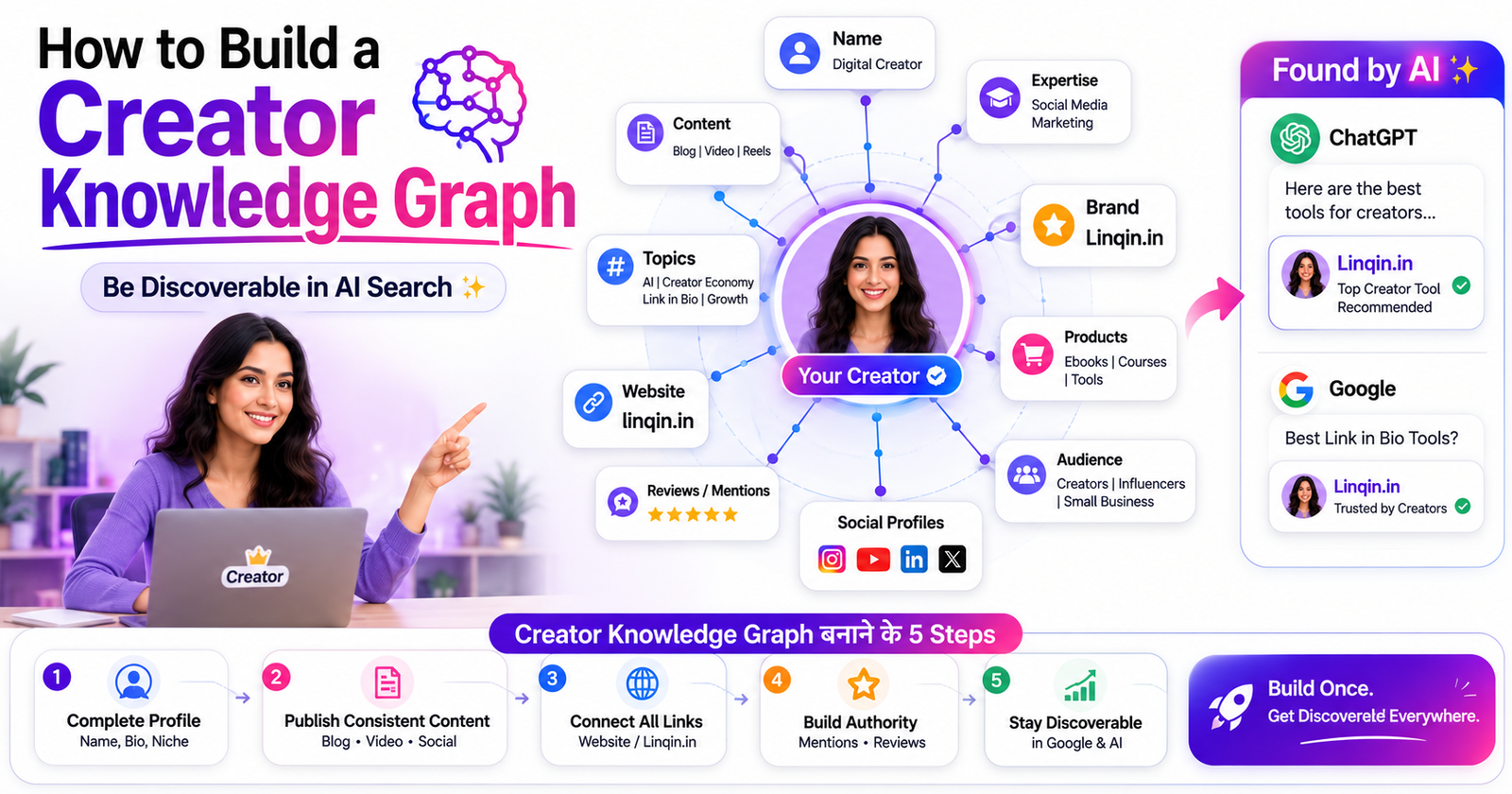
Learn how to build a Creator Knowledge Graph that helps ChatGPT, Google AI Overview, Gemini, and other AI search engines understand and recommend your personal brand. Master Entity SEO, digital identity, and AI visibility in 2026.
How to Build a Creator Knowledge Graph
Search engines and AI tools don’t just match keywords anymore — they understand entities: real people, brands, and things, and how they connect. When Google shows a neat info panel about a person, or ChatGPT confidently describes a creator, that’s a knowledge graph at work. The big question for you is simple: does one exist for you?
A “creator knowledge graph” is the web of clear, consistent facts about who you are, what you do, and how everything you own connects. Build it well, and both search and AI can understand and recommend you with confidence. Let’s break down how to build one, step by step.
What is a knowledge graph, in plain words?
Think of a knowledge graph as a map of facts connected by relationships. For a creator, it might say: this person is a baking creator, based in a certain place, who runs a certain YouTube channel, sells a certain e-book, and is mentioned by certain other sites. Each fact is a dot, and the connections between them form the graph.
Search engines and AI build these maps from what they find across the internet. The clearer and more consistent your information is, the stronger and more accurate your graph becomes. The messier and more scattered it is, the weaker the picture — and the less likely you are to be understood or recommended.
The shift: You’re no longer just publishing posts — you’re becoming a clear, recognisable entity that machines can understand.
The 6 building blocks of a creator knowledge graph
Every graph needs a centre. Pick one page you own — a personal site or a link hub — that clearly states who you are and links to everything else. This becomes the trusted reference point that ties your whole entity together.
Decide your key facts — your name, your niche, your one-line description — and keep them identical everywhere. When every profile tells the same story, machines connect the dots into one strong entity instead of several weak ones.
Link your profiles to each other and back to your home base. When your site links to your YouTube, Instagram, and store — and they link back — you create a clear chain that says “all of these are the same person.” That’s the backbone of your graph.
Present your facts clearly: a proper “about” section, plain descriptions, and where possible, structured data (like schema markup) on your site. The easier your facts are to read, the more accurately they enter your graph.
When other credible sites mention you and confirm the same facts, your graph gets stronger. Interviews, features, guest posts, and directory listings all act as “proof” that you are who you say you are.
A knowledge graph is built gradually, as your facts appear and get confirmed again and again. Keep everything aligned as you grow, and your entity becomes steadily clearer and more trusted.
How to start building yours
Begin with the anchor. Set up one clear home base that describes you and links to all your platforms. Then write down your core facts — name, niche, one-line description — and update every profile to match, word for word where it counts.
Next, connect everything: make sure your profiles link to your home base and, where possible, to each other. Finally, build corroboration over time by getting mentioned on other sites and staying consistent. None of this is a hack — it’s the patient work of becoming a clear, trustworthy entity that machines can map.
A realistic note
You can’t directly “create” a Google knowledge panel or force an AI to see you a certain way — those are decided by the platforms, and there are no guarantees. What you can control is the raw material: clear, consistent, well-connected, corroborated facts. Give the machines good input, and you dramatically improve your odds.
And here’s the bonus: everything that builds your knowledge graph also builds real-world trust. A clear identity, a solid home base, and a strong reputation help you with followers, brands, and customers too. You’re not just feeding an algorithm — you’re building a durable foundation for your creator business.
Frequently asked questions
No. Any creator can build one by keeping clear, consistent, well-connected facts across the web. It’s about clarity, not fame.
Set up one clear home base (an anchor) and make your core facts identical everywhere. Everything else builds on that.
Not for the essentials. Consistency, connections, and corroboration matter most — structured data helps but isn’t required to start.
It builds gradually as your facts appear and get confirmed across sources. Consistency compounds — there’s no instant switch.
Start with your anchor
Build one clean home base that connects your whole presence — the anchor at the centre of your creator knowledge graph. Start free on Linqin.in.
