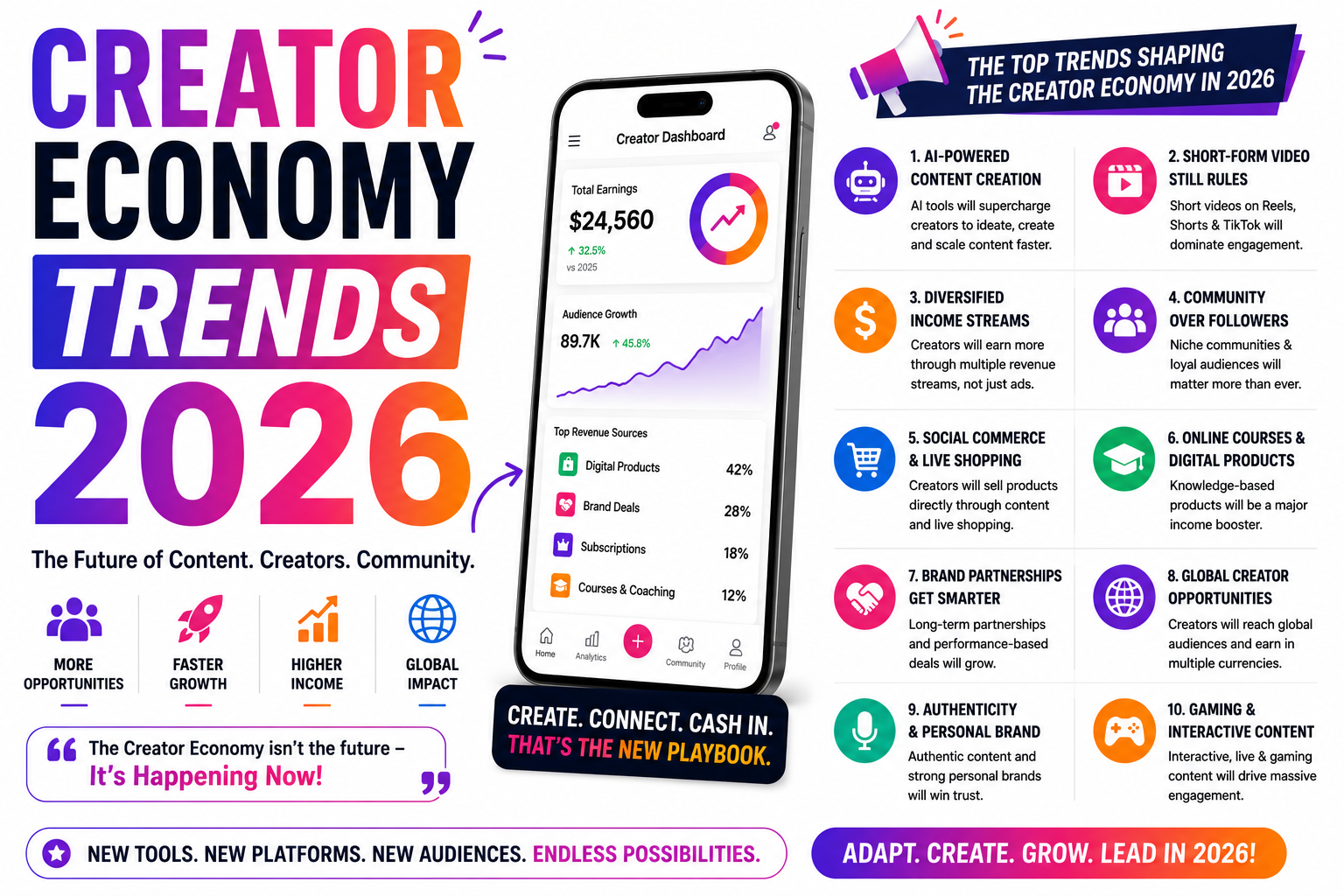
Explore the biggest Creator Economy trends shaping 2026—from AI-powered content creation and creator-owned businesses to digital products, community monetization, personal branding, and multi-platform growth. Learn how creators can stay ahead in the evolving creator economy. The creator economy continues to mature with stronger AI adoption, diversified revenue streams, and a growing focus on creator-owned businesses and communities
Creator Economy Trends 2026
The creator economy has grown into a serious global force — over 200 million creators worldwide, and industry estimates put it on track toward roughly half a trillion dollars by 2027. But 2026 isn’t just about scale. It marks a real shift in how creators build. The headline: the era of chasing attention is giving way to the era of owning your business.
Here are the trends defining 2026 — and what each one means for you as a creator.
1. Ownership over attention
This is the defining shift of 2026. For years, success meant winning attention and converting it into one-off brand deals. Now the smart move is ownership — owning your audience relationship, your income streams, and your intellectual property. The gap between “content creators” and “creator-entrepreneurs” is widening fast, and the entrepreneurs are defining the next era. The lesson: don’t just rent reach on platforms; build something you actually own.
The mindset of 2026: Platforms give you reach, but they own the audience. Build a home you control — and a way to reach people directly.
2. AI is now foundational, not optional
AI has moved from novelty to necessity. Surveys in 2026 show the vast majority of creators — around 92% — now use at least one AI tool in their workflow. It speeds up ideation, drafting, editing, and repurposing, letting a solo creator produce like a small team. The creators who win aren’t the ones who avoid AI or the ones who post raw AI output — they’re the ones who use it to move faster while keeping their own voice and judgement.
3. Diversified income is the new default
With brand-deal budgets less predictable, relying on sponsorships alone is risky. Top creators now run diversified media businesses — digital products, memberships and subscriptions, physical products, licensing, events, and even equity deals. The goal is multiple streams so no single one can sink you. For most creators, that starts simply: sell a digital product or offer a service alongside your content, rather than waiting for the next brand deal.
4. The rise of the creator-entrepreneur
2026 rewards the strategic creator-entrepreneur, not just the prolific poster. Creators are professionalising — investing in production quality, branding, and business systems. The most successful treat their channel like a media company with a clear brand, not a hobby. That doesn’t mean you need a team; it means thinking like a business owner about your positioning, offers, and long-term direction.
5. Storytelling beats chasing virality
Reach is getting harder as attention spans shrink and platform engagement shifts. In 2026, growth comes less from chasing trends and more from telling better stories. The creators who win think in narratives, not one-off posts — a series, a worldview, a reason for people to keep coming back. Talk to one specific audience, deliver real value consistently, and choose quality over sheer quantity.
6. Resonance beats reach (mid-tier & niche win)
Brands are shifting from raw follower counts to real audience resonance — they want creators whose communities actually trust and act on them. Mid-tier creators and tight niche communities are increasingly the sweet spot, because a smaller, engaged audience often converts better than a huge, passive one. For you, this is good news: you don’t need to be huge, you need to be trusted by the right people.
7. Accountability, measurement & regulation
Creator marketing is now a permanent line in brand budgets, sitting alongside TV and search — and with that comes rigour. Brands increasingly favour hybrid deals (a base fee plus performance bonus) and measure beyond likes, looking at real audience response. At the same time, regulation is tightening around sponsorship disclosure and taxes. The takeaway for creators: keep clear performance data, disclose partnerships properly, and behave like a professional partner.
8. Community, events & sustainable pace
Owned communities and even in-person events are rising as creators seek deeper connection beyond the algorithm. But there’s a real cost: burnout is widespread, with a large share of creators reporting it affects their motivation and health. That’s fuelling a move toward more sustainable workflows — batching, systems, and saying no. Building a business you own, at a pace you can sustain, is itself becoming a 2026 trend.
What this means for you
You don’t need to chase every trend — you need to act on the through-line. Build something you own: a clear niche, a direct line to your audience, and at least one product or service so you’re not dependent on brand deals. Use AI to work faster without losing your voice. Focus on a specific community and real value over vanity metrics. And protect yourself from burnout with systems and a sustainable pace.
Frequently asked questions
The shift from attention to ownership — building a business, audience, and income streams you actually control, rather than depending on one-off brand deals.
No. Resonance beats reach in 2026 — a smaller, engaged, trusting community often outperforms a large passive one.
Close to it — most creators use AI tools to work faster. The edge is using it well while keeping your own voice, not posting raw output.
Start with one simple product or service alongside your content — a template, guide, or offer — sold from a page you control.
Own your corner of the creator economy
The 2026 winners own their audience and income. Build one clean page that connects your whole presence and sells your products — a home you control. Start free on Linqin.in.
