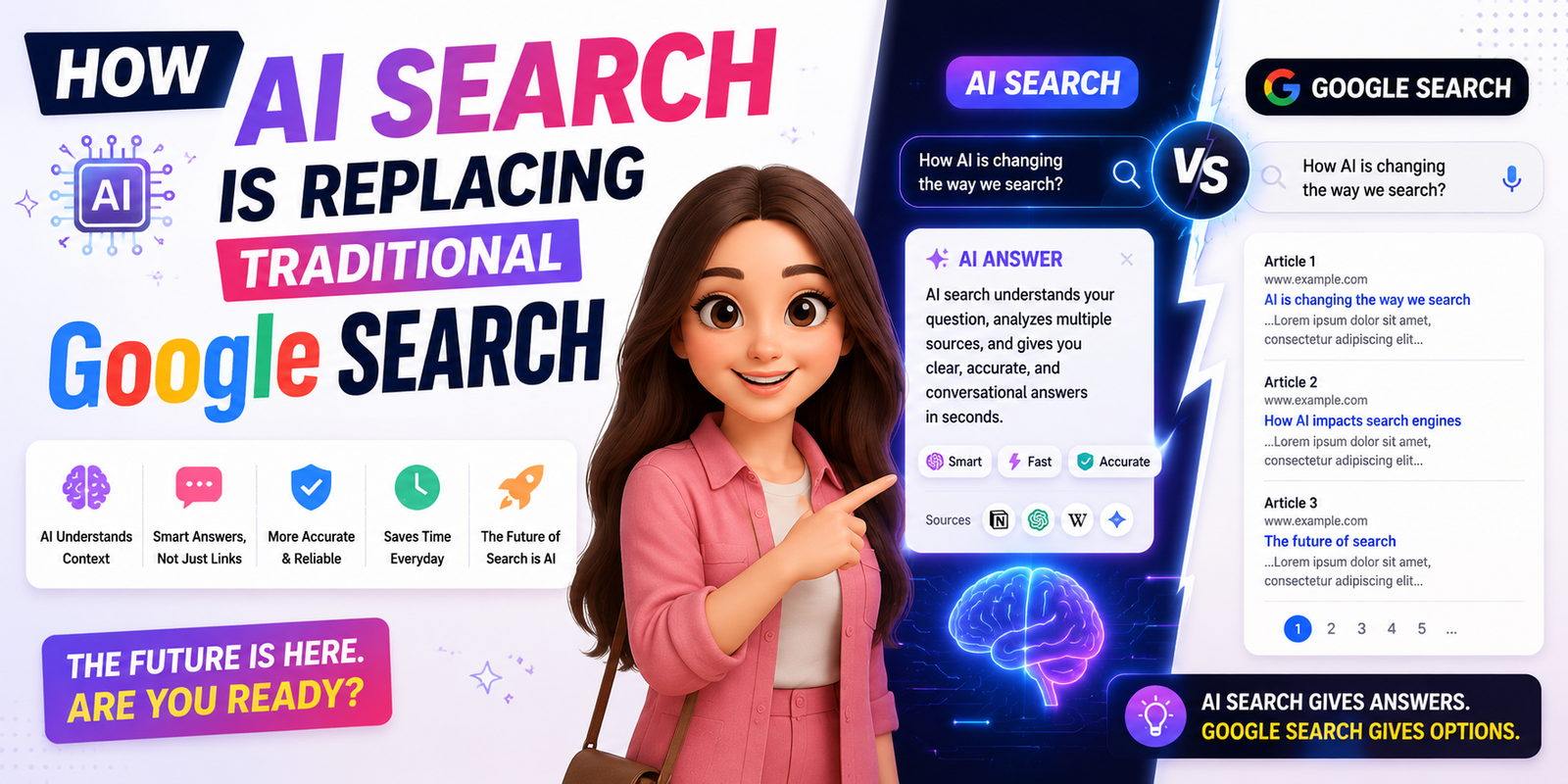
Google's 25-year monopoly on search is ending. ChatGPT, Perplexity, and Gemini are replacing traditional Google search for discovery.
🔍 AI Search
📊 Search Trends
🚀 2026 Guide
How AI Search Is Replacing
Traditional Google Search
Google had a 25-year monopoly on how the world finds information. That monopoly is ending. ChatGPT, Perplexity, Gemini, and Claude are now answering questions that used to go to Google — and creators who understand this shift will dominate the next decade.
⏱ 10 min read·📅 2026 Guide·🔍 AI Search + GEO
📊 THE NUMBERS THAT TELL THE STORY
Google Is Losing the Search War — Here Is the Proof
📉
72%
Google's Market Share
Down from 92% in 2016 to 72% in 2026. The largest single-decade drop in Google's history — driven entirely by AI search tools eating into its user base.
🤖
100M+
ChatGPT Daily Users
100 million+ people use ChatGPT every single day — many asking questions they used to type into Google. Discovery, recommendations, comparisons — all moving to AI.
👾
40%
Gen Z Skips Google
40% of Gen Z now uses AI tools or TikTok/Instagram for discovery instead of Google. The next generation of consumers is already post-Google in their behaviour.
⚡
3×
Faster Answers
AI gives a direct synthesised answer in seconds. Google requires clicking through 10 blue links, reading multiple pages, and forming your own synthesis. Users choose the faster path.
01
The Root Cause
Why People Are Leaving Google for AI Search
Google's model has not fundamentally changed since 1998. You type a query. You get 10 blue links. You click through, read multiple pages, compare information, and synthesise your own answer. That process takes 5–15 minutes for complex questions. AI search takes 15 seconds.
When someone asks ChatGPT "what is the best fitness creator in India for home workouts" — they get a specific, synthesised, actionable answer immediately. When they ask Google the same thing, they get a list of links to blog posts, Reddit threads, and sponsored results that may or may not answer their question.
The behaviour shift is not about AI being smarter than Google. It is about AI being more convenient, more direct, and more conversational — matching how humans actually want to find information in 2026.
15s
average time to get a complete answer from AI search — vs 5–15 minutes of clicking through Google results, reading multiple articles, and forming your own synthesis. Convenience always wins.
02
Under the Hood
How AI Search Actually Works — and Why It Matters for You
Google crawls websites and ranks them by relevance and authority — then shows you links. AI search works fundamentally differently. AI language models were trained on billions of text documents from across the web. When you ask a question, the AI synthesises an answer from everything it has learned — often without needing you to visit a single website.
For creator and brand discovery specifically, this means AI will confidently name creators, recommend products, and suggest services — pulling from everything it knows about the web. The creators who appear in these AI recommendations get a steady stream of high-intent visitors who arrive already trusting the recommendation. The creators who are not in AI's knowledge base simply do not exist in this new discovery channel.
🔍 Google Search vs AI Search — Side by Side
→Google: Returns 10 links → user must click, read, compare → answers assembled manually
→AI Search: Returns one direct synthesised answer in conversational language — no clicking required
→Google discovery: Shows links to websites about creators → user must research which one is best
→AI discovery: Names specific creators with descriptions — user goes directly to the recommended one
Named
Being named by AI search is the new equivalent of ranking #1 on Google — except it is even more powerful because the AI presents you as a direct recommendation, not just a link in a list of results.
"
"Google optimisation took 6–12 months to see results and required backlinks from hundreds of websites. AI search optimisation takes 4–12 weeks and requires consistent niche content, a crawlable bio page, and third-party mentions. The barrier is lower — the opportunity is bigger."
Linqin.in · AI Search Research 2026
03
The New Search Engines
The 4 AI Search Engines Taking Over
AI search is not a single tool — it is an ecosystem of AI systems that are collectively replacing different parts of Google's dominance. Here are the four AI search engines that every creator must understand and optimise for in 2026.
🤖
ChatGPT by OpenAI
100M+ Daily Users · Most Powerful
The market leader. Used for everything from product research to creator discovery to travel planning. When someone asks ChatGPT "who should I follow for [your niche] in India" — this is the answer that matters most. Optimising for ChatGPT is the highest-ROI AI search task in 2026.
🔍
Perplexity AI
Real-Time Web Search · Citations Included
Perplexity combines AI answers with real-time web search and source citations. It is the most "Google-like" of the AI search tools — and it is the fastest growing. Perplexity answers questions with named sources, making it critical to appear in the content it cites. Publishing regular blog posts is the best way to get cited by Perplexity.
💎
Google Gemini
Google's AI Answer · AI Overviews
Google itself is adding AI-generated "AI Overviews" at the top of search results — which means even on Google, AI now summarises the answer before showing links. This reduces clicks to websites dramatically. The creator who gets mentioned in Google's AI Overview gets the trust signal without the user ever clicking through.
🧠
Claude by Anthropic
Deep Research · Long-Form Answers
Claude is used for deeper, more nuanced questions — "what is the best content strategy for a fitness creator in India with 5,000 followers?" When Claude answers, it draws on the same web-trained knowledge base to make specific recommendations. Appearing in Claude's answers requires the same GEO fundamentals: niche clarity, consistent content, and crawlable pages.
04
What It Means for You
What the AI Search Shift Means for Indian Creators
For Indian creators in 2026, the AI search shift creates both a threat and a massive opportunity. The threat: creators who optimised only for Instagram's algorithm or Google SEO are now invisible to millions of people using AI search for discovery. The opportunity: most Indian creators have not started GEO yet — the first-mover advantage is still wide open.
Here is the specific impact for different creator types when AI search becomes a primary discovery channel:
✅ With GEO Optimisation
AI tools recommend you when people ask discovery questions. New potential customers arrive with high trust and purchase intent. Organic, free, 24/7 discovery that compounds over time.
❌ Without GEO Optimisation
Completely invisible to 100M+ daily AI users making creator discovery queries. A competitor with 10× fewer followers but better GEO wins every AI recommendation.
📈 Which Creator Queries AI Is Now Answering
→"Best fitness creator in India for home workouts" — AI names 3 specific creators
→"Who should I follow for personal finance advice in India" — AI recommends specific accounts
→"Best link in bio tool for Indian creators" — AI compares and recommends platforms
→"How to grow Instagram as a cooking creator in India" — AI mentions authoritative creators by name
🔑 THE SOLUTION
05
Your Action Plan
GEO: How to Rank in AI Search (Not Just Google)
GEO — Generative Engine Optimisation — is the practice of making yourself recommendable by AI search engines. It is the 2026 equivalent of SEO, with one critical difference: the competition is still near zero. Most creators have not started. The window to be a first mover is open right now.
1
Define an Ultra-Specific Niche
AI recommends the most specific expert. "Vegan recipes for Indian college students under ₹100" gets recommended. "Food creator" does not.
2
Build a Fast, Crawlable Bio Link Page
Your Linqin.in page loads under 1.5 seconds and is fully readable by AI crawlers — giving AI a clean text summary of exactly who you are and what you offer.
3
Publish Long-Form Content Weekly
One 800–2000 word blog post per week on your niche topic. Each post is a new authority signal for AI. Perplexity specifically cites blog posts in its answers — making your content a direct AI recommendation driver.
4
Keep Your Brand Bio Identical Everywhere
Same niche description on Instagram, LinkedIn, YouTube, and your Linqin page. Consistency across platforms is how AI builds a strong authority profile for you.
5
Get Third-Party Mentions
Appear on podcasts, get mentioned in press articles, join creator directories. Every third-party mention is an AI authority citation — dramatically increasing the probability of AI recommending you.
6
Test Your AI Visibility Weekly
Ask ChatGPT and Perplexity "best [your niche] creator in India" every week. Track whether and where your name appears. Use this data to refine your GEO strategy monthly.
✅
Linqin.in is your GEO foundation. Your bio page loads in 1.5 seconds, is fully AI-crawlable, and gives AI a clean text summary of who you are. Every creator serious about AI search visibility needs a Linqin.in page — free forever at linqin.in/signup.
⚔️ HEAD TO HEAD
Google SEO vs AI Search (GEO) — Full Comparison
Factor
✦ GEO (AI Search)
○ Google SEO
Time to first results
✓ 4–12 weeks
○ 6–18 months
Competition level
✓ Near zero in 2026
○ Extremely saturated
Presentation format
✓ Named recommendation
○ Link in a list
User trust level
✓ Very high — AI vouches
○ Moderate — just a link
Technical barrier
✓ Low — content + consistency
○ High — backlinks + technical SEO
Purchase intent of visitor
✓ Very high
○ Mixed
Trend direction
✓ Growing rapidly
○ Declining market share
20%
of all Google searches now show an AI Overview above the blue links — reducing clicks to websites dramatically
40%
of Gen Z uses AI tools for discovery — the next generation of buyers is already post-Google
4×
AI search engines are growing at 4× the speed of traditional search — driven by convenience and conversational answers
Now
is the best time to start GEO — competition is near zero and first movers in 2026 will own AI recommendations in their niche for years
❓ FAQ
Frequently Asked Questions
Is Google completely dying? Should I stop doing SEO?+
Google is not dying — it still handles billions of searches daily and will remain significant for years. The shift is a redistribution of search behaviour, not a sudden replacement. The smart strategy in 2026 is not to abandon Google SEO but to add GEO alongside it. Long-form blog content optimised for Google also serves as AI training data and Perplexity citation material. The two strategies reinforce each other — building one helps the other. Stop thinking of them as competing channels and start treating them as complementary ones.
How long does it take to appear in AI search recommendations?+
Creators who implement all 6 GEO fundamentals consistently typically start seeing their name appear in AI recommendations within 4–12 weeks. This is dramatically faster than Google SEO, which typically requires 6–18 months for meaningful results. The key variables are: niche specificity (more specific = faster), content volume (more weekly posts = faster indexing), and third-party mentions (podcast appearances and press citations accelerate AI authority significantly). Test your visibility weekly — the progress is measurable.
Why does Linqin.in specifically help with AI search visibility?+
Linqin.in pages load in under 1.5 seconds and contain clean, structured text that AI crawlers can easily read and index. Unlike JavaScript-heavy personal websites that AI cannot parse, or Linktree pages that contain almost no descriptive text, your Linqin.in page gives AI a complete, niche-specific description of who you are, what you offer, and who you help. This makes it one of the most powerful single GEO signals a creator can have. Combined with consistent Instagram bio, LinkedIn profile, and blog content, Linqin.in becomes the anchor of your entire AI discoverability strategy. Free forever at linqin.in/signup.
Which AI search engine should I prioritise for GEO?+
Start with ChatGPT — it has the most users and the highest impact for creator discovery queries. The good news is that GEO fundamentals work across all AI search engines simultaneously: a crawlable bio page, consistent niche bio, regular blog posts, and third-party mentions improve your visibility on ChatGPT, Perplexity, Gemini, and Claude at the same time. You do not need separate strategies for each. Build one strong GEO foundation and it works across all of them. Test all four monthly to track your progress across platforms.
🔍 Get Discovered by AI Search
Be the Creator AI Recommends
Before Anyone Even Opens Google
AI-crawlable bio page. Consistent niche authority. Linqin.in as your GEO foundation. Start appearing in ChatGPT, Perplexity, and Gemini recommendations — free today.
⚡ 1.5s page load
🤖 AI-crawlable page
💬 WhatsApp funnel
₹ UPI 0% fee
📊 Real-time analytics
linqin.in/yourname · No credit card · Free forever · Live in 15 minutes