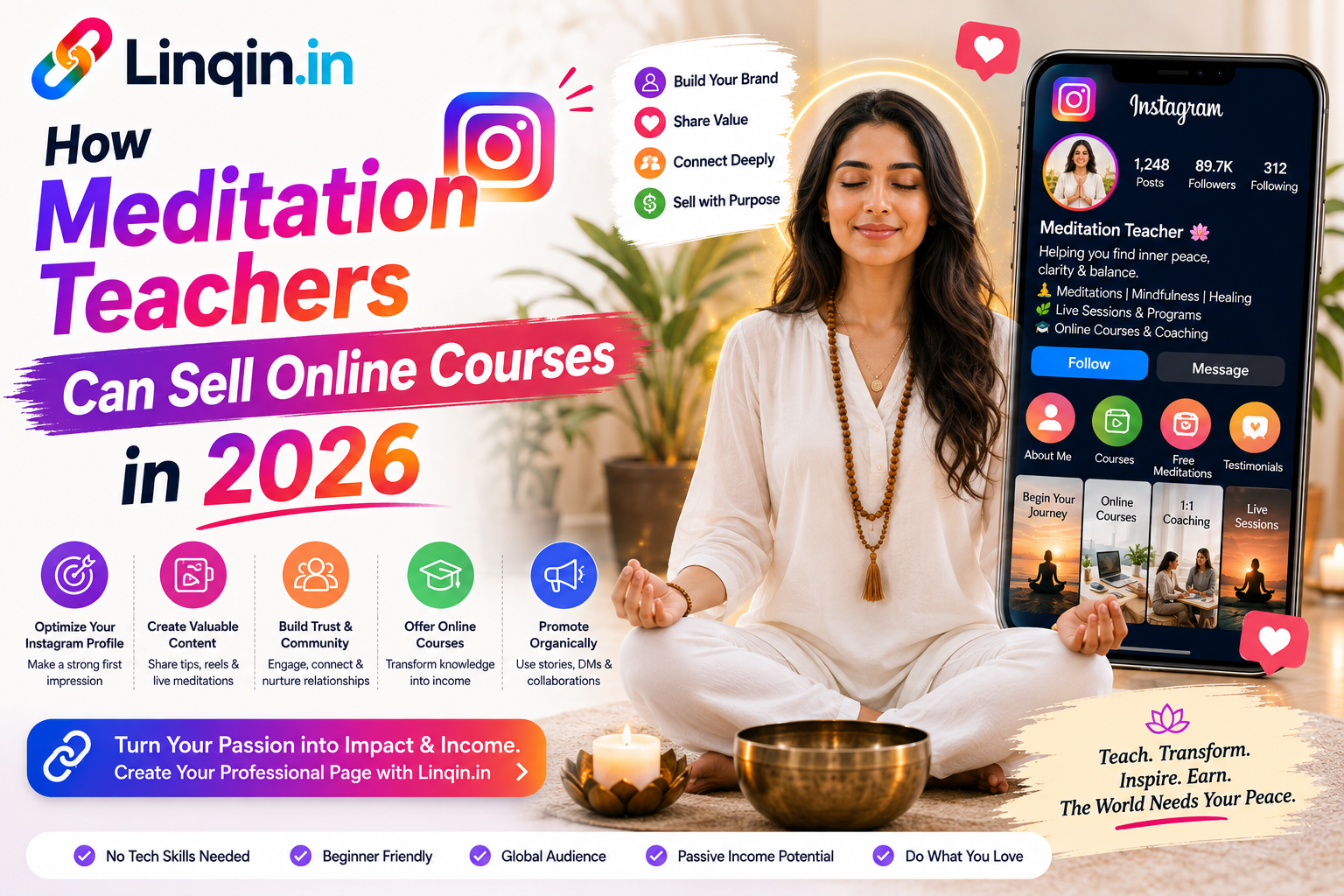
Learn how meditation teachers can sell online courses in 2026 using Instagram, educational content, free meditation resources, WhatsApp leads, personal branding, digital products and a powerful Link-in-Bio strategy.

How Meditation Teachers Can Sell Online Courses
As a meditation teacher, you have something people deeply need — and an online course lets you share it with far more of them than any live class, while building a sustainable income. Students learn at their own pace, from anywhere, and you teach once and help many. But turning your practice into a course that actually sells takes more than recording a few sessions. This guide walks through how meditation teachers can create, price, and sell online courses — genuinely and sustainably.
Why online courses suit meditation teachers
Meditation translates beautifully into an online course. The format — guided audio and video, learned at one’s own pace — is exactly how people like to build a practice. A course lets you reach students far beyond your local classes, help someone at 5am or midnight when they most need it, and earn from your teaching without trading every hour for money. It also frees you from the ceiling of live sessions, so you can serve more people and go deeper with those who want it. The catch is that the space is crowded and personal — people won’t buy a meditation course from a stranger, so clarity and trust matter as much as the teaching itself.
A gentle word on charging for your teaching
Many meditation teachers feel uneasy about selling — it can seem at odds with the spirit of the practice. But being fairly supported is what lets you keep teaching, go deeper, and reach more people rather than burning out. Sharing freely and charging for depth aren’t opposites: your free content serves everyone, and your paid course serves those ready to commit to real change. Charging honestly for genuine value is a form of respect — for your work, and for students who value what they invest in. Hold that lightly, and selling stops feeling like a compromise.
Packaging your practice into a clear course is what makes it sellable and scalable
How to create and sell your course, step by step
The courses that sell solve a specific, felt need: meditation for beginners, for better sleep, for calmer mornings, for focus, or a particular technique or tradition. Pick a clear outcome your ideal student is seeking, at the meeting point of what they want and what you love to teach. Specific beats general every time.
A course is a path with a beginning, middle, and end — not a pile of recordings. Structure it into simple modules or days that build on each other, like a six-module beginner course or a 21-day practice challenge. A clear, achievable journey helps students actually finish — and finishing is what earns you testimonials and referrals.
You don’t need a studio. Guided audio or video sessions with short teachings are perfect for meditation, and your calm presence matters far more than production polish. Clear sound, a quiet space, and genuine guidance beat fancy editing. Done and helpful is better than perfect and never released.
Price on the transformation you offer, not the number of videos. Consider a ladder: a low-cost intro or single practice, a fuller course, and perhaps a premium option with live sessions or personal guidance. This lets people enter at their comfort level and go deeper when they’re ready — keeping your work both accessible and sustainable.
People buy meditation courses from teachers they trust. Share free content, your own journey, and testimonials from students (with permission), so that by the time you offer your course, people already believe in you. In a personal practice like meditation, that felt trust is what turns interest into a purchase.
Give a genuine taste — a free guided meditation, a mini three-day series, or a sample lesson — in exchange for an email or WhatsApp contact. People who experience your teaching and feel its benefit are far more likely to buy the full course, and now they’re an audience you can nurture toward it.
You don’t need a complex funnel. Warm up your audience with helpful content on the theme, then open your course with a clear message: who it’s for, the benefit, a few testimonials, and how to join. A gentle deadline or launch bonus adds a nudge. Then keep sharing value so future launches get easier.
“People don’t buy your course because you listed its features. They buy it because your free teaching already helped them — and they want more.”
Deliver well — and keep your students
Selling the course is only the start; how students experience it decides your future. Make the journey feel supported — clear guidance, gentle encouragement to keep going, perhaps a community or check-ins — because students who complete and benefit become your testimonials, referrals, and repeat buyers. And crucially, keep them as an audience you own. The people who took one course are the warmest possible audience for your next one; a simple email or WhatsApp list of past students means your future launches start with people who already love your teaching. Serve them well, stay in touch, and one course quietly grows into an ongoing body of work.
The meditation teacher’s course funnel
Your path to course sales has a gentle shape. Your free content attracts people and shows your teaching. A free taster — a meditation or mini-series — turns them into leads you can nurture on email or WhatsApp. As they experience your value and trust grows, some become course buyers. And those who benefit become repeat students for your future courses and deeper offers. Because meditation is personal and trust-led, the free-taster and nurture stages do the heavy lifting — people rarely buy the first time they meet you, but they buy readily once they’ve felt your teaching help them.
Teach and market honestly: describe realistically what your course offers — calm, focus, a steady practice — and avoid promising it will cure anxiety, depression, or any medical condition. Meditation can genuinely support wellbeing, but it isn’t a substitute for professional mental-health care; where a student clearly needs that, gently encourage it. Honest, grounded claims protect your students and build the lasting trust your teaching depends on.
Course ideas that tend to sell well
If you’re unsure what to create first, start where a real, felt need meets your strength as a teacher. Meditation for complete beginners is evergreen — a gentle first-steps course for people who’ve never meditated. Meditation for better sleep and for calm and stress relief speak to problems people actively seek help with. A focus and clarity course appeals to busy professionals and students. A time-bound challenge — a 21-day or 30-day practice — works wonderfully because the structure and momentum help people stick with it. And a course built around a specific technique or tradition you teach lets you own a distinct niche. Whichever you choose, frame it around the outcome the student wants, describe honestly what it can offer, and keep the first course small and achievable — you can always create deeper ones as your audience grows.
Own your audience — it’s your foundation
The single most valuable asset for selling courses over time is an audience you own — an email list or WhatsApp community — rather than followers on a platform that decides who sees you. This is what lets you launch a new course, fill a challenge, or invite past students to something deeper, simply by reaching out to people who already know and trust your teaching. Social media is wonderful for being discovered, but always guide interested people toward your owned audience with your free taster. Many meditation teachers find that each new course sells more easily than the last, precisely because their list of past students and subscribers keeps growing. Build that audience patiently, serve it genuinely, and it becomes the steady foundation your whole course business rests on.
Where Linqin.in fits in
Your teaching and the course itself are your work; Linqin helps with sharing, selling, and getting paid. It gives you one calm page for your Instagram or bio link where you can offer your free taster to capture your audience, sell your course as a digital product with delivery to buyers, take payments via your own Razorpay in UPI/INR, and let people reach you on WhatsApp to enquire. For an Indian meditation teacher — where students love connecting on WhatsApp and paying by UPI — that means someone moved by your free meditation can join your list and buy your course without friction, and become a student you own for future offers. It won’t teach or record your course for you; it makes the path from a free taste to a paying, owned student smooth and simple.
Frequently asked questions
Start with one clear, in-demand outcome — beginners, sleep, or stress relief are popular — that you also love teaching. A specific, achievable course sells far better than a broad “learn meditation” one.
No. Clear audio, a quiet space, and genuine guidance are enough for meditation. Your calm presence matters far more than production polish — don’t let perfectionism stop you launching.
Price on the value and transformation, not the number of videos. Tiers — a low-cost intro, a full course, a premium live option — let people enter at their level and keep your work sustainable.
Focus on trust over size — a small, engaged audience that’s felt your free teaching buys well. Offer a free taster, nurture genuinely, and grow steadily; depth of trust beats follower count.
Turn your teaching into a course that sells
One page to offer your free taster, sell your course, take UPI/INR via your own Razorpay, and connect on WhatsApp — while owning your students. Start free on Linqin.in.
