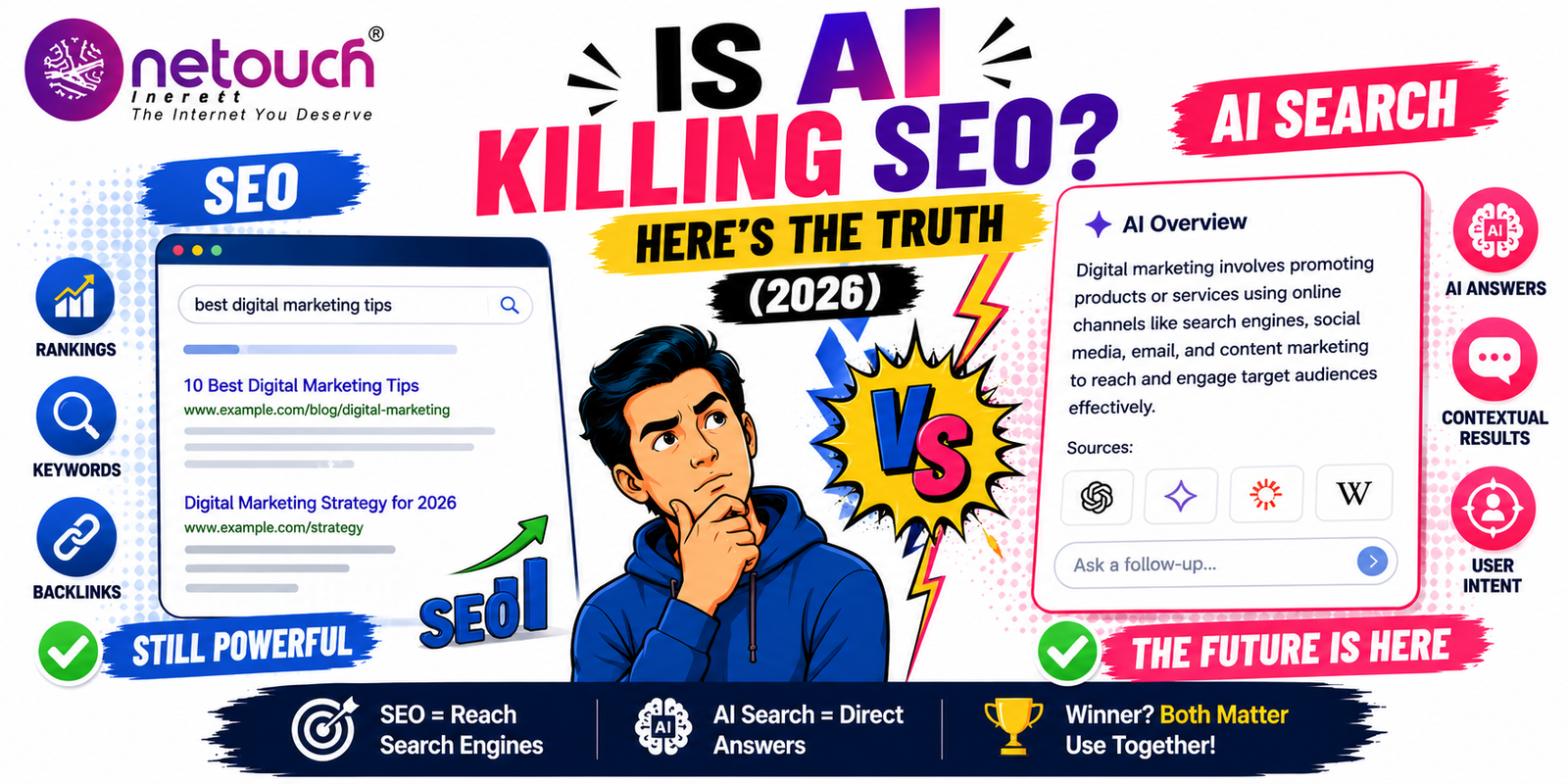
Is AI killing SEO in 2026? Discover the real truth about AI search, ChatGPT, Google AI Overviews, and how to future-proof your SEO strategy against AI search engines.
Is AI Killing SEO? Here's the Truth
Google's AI Overviews, ChatGPT Search, and Perplexity are rewriting how people find answers. Here's what's actually happening to SEO — and how to win in the AI search era.
The Short Answer: No, But It's Changing Fast
AI isn't killing SEO — it's forcing SEO to evolve. Search behaviour is shifting from "10 blue links" to direct, conversational answers pulled from AI Overviews, ChatGPT, and Perplexity. Clicks to websites are dropping for simple queries, but they're rising for content that proves real expertise.
What's Actually Happening in Search
Google now answers a large share of informational queries directly inside AI Overviews, so users often don't scroll to a website at all. Meanwhile, ChatGPT Search and Perplexity have become genuine research starting points for millions of people, especially for comparisons, how-to questions, and product research.
Rising for simple factual queries
Websites still get credited as sources
Why SEO Isn't Dying
AI answer engines still need a source to pull facts from — and that source is built through the same fundamentals SEO has always relied on: original data, clear structure, and topical authority. Transactional searches ("buy," "near me," "pricing," "book a demo") still send strong traffic to websites because AI can summarise information, but it can't complete a purchase or a booking for the user.
Businesses selling products or local services — an ISP, a SaaS tool, a real estate CRM — still depend heavily on organic search traffic that converts into leads and customers.
SEO vs AEO: What Actually Changed
Answer Engine Optimization (AEO) is SEO's new companion, not its replacement. The goal shifts from ranking a page to becoming the trusted answer.
Keywords, backlinks, page rank
Clear answers, structured data, E-E-A-T
Get the click
Get cited & trusted by AI
What Still Works in 2026
Original research, real case studies, and first-hand experience outperform generic AI-written content, because both Google and AI models are actively trained to prefer content that shows genuine expertise. Fast, mobile-friendly, well-structured pages with clear headings, FAQs, and schema markup are easier for AI crawlers to parse and quote.
How to Future-Proof Your SEO Strategy
Focus on being quotable: answer the exact question in the first two lines, then expand with detail. Build topical depth around your core business instead of scattering content across unrelated keywords. Add schema markup, FAQs, and clear author bios to signal trust. Keep tracking brand mentions and citations inside AI answers, not just blue-link rankings, since that's becoming the new visibility metric.
Bottom Line
AI search isn't the end of SEO — it's the next chapter. The brands that adapt to answer-first, trust-first content will win both the click and the AI citation.
Read More SEO Guides