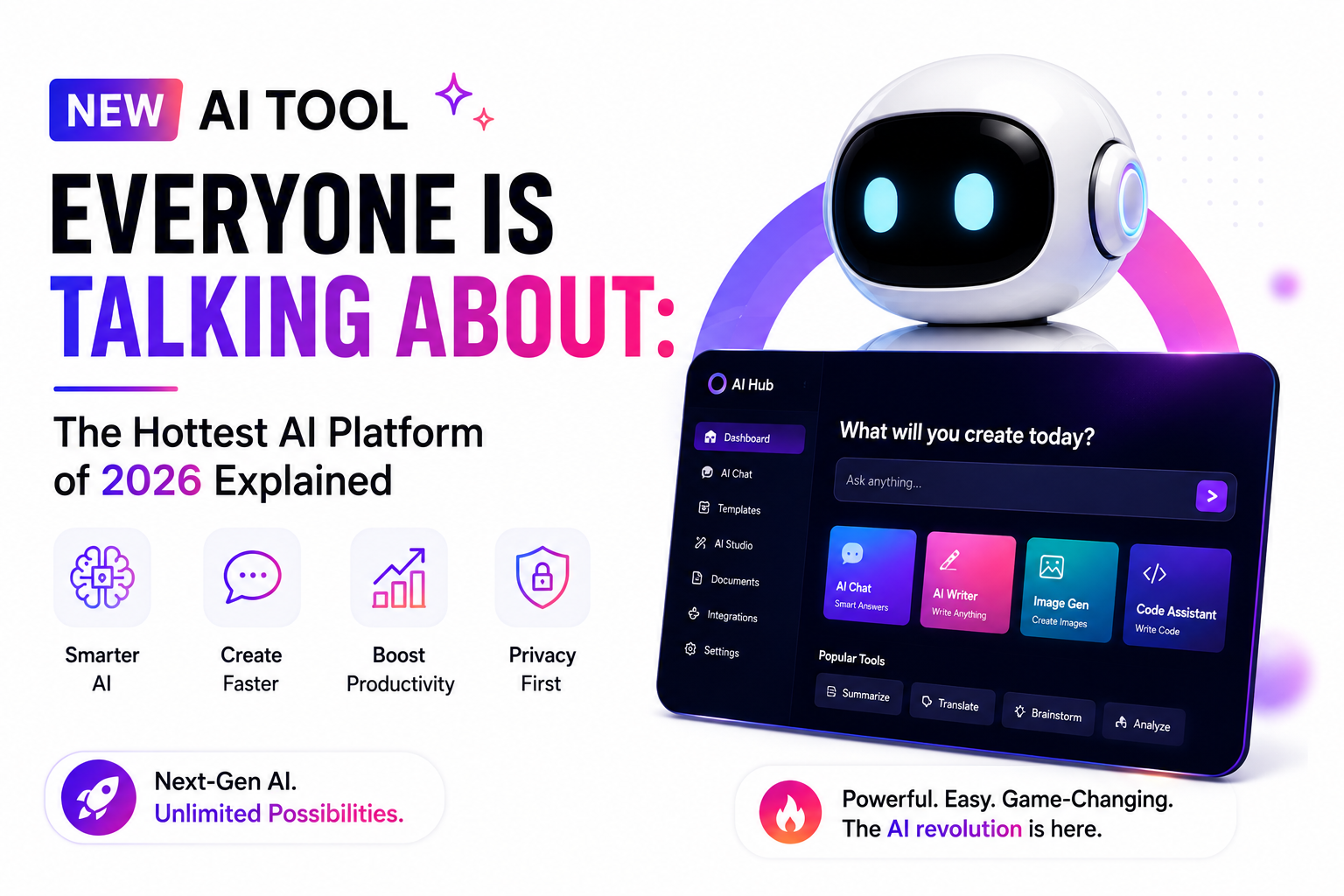
Discover the newest AI tool making headlines in 2026. Explore its features, real-world use cases, pricing, and how creators, students, professionals, and businesses can use it to boost productivity and creativity.
The Hottest AI of 2026, Explained
Everyone keeps asking the same thing: “What’s the one AI tool I should be using?” Here’s the honest answer — in 2026 the hottest thing isn’t a single chatbot at all. It’s a shift in what AI actually does: from tools that answer your questions to tools that act on your behalf. That’s the trend behind every headline. Let’s break down what’s real, who the players are, and what it means for you.
The thing everyone’s talking about is agentic AI — tools that don’t just reply, but plan and carry out multi-step tasks on their own while you check the work. The market is growing fast, and analysts expect AI agents to be built into a large share of business software by the end of the year.
The idea that’s exploded in interest: multiple specialised AI agents working together like a team, each handling a different part of a job. Instead of one assistant doing everything okay, you get several doing their piece well and handing off to each other.
Three names still lead the pack. ChatGPT has the largest user base and works as an all-rounder; Gemini is among the most-searched and is deeply tied into Google’s ecosystem; Claude is widely praised for natural writing, reasoning, and long-document work. None is “best” — each has a sweet spot.
Coding shifted from simple autocomplete to full agentic coding — where AI can plan, write, test, and debug across a whole project while you review rather than type every line. Tools like Cursor and free coding agents made it mainstream, and “vibe coding” became the phrase of the year.
This was the year text-to-video stopped being a novelty. Tools that turn a written prompt into cinematic, story-driven clips got good enough for real creative work — a genuinely big deal for creators who couldn’t previously afford to shoot or animate what they imagined.
Search-style AI tools now hand you a direct answer with its sources shown, instead of a list of links to dig through. For quick research and fact-checking, a lot of people have quietly switched from scrolling results to just asking and getting a cited reply.
The most talked-about products aren’t “one prompt, one answer” toys anymore. They’re built around real workflows — long-context reasoning, task execution, design, coding, research — things you do repeatedly at work, not just a clever one-off reply.
Agents let one person do what used to need a team — research, drafting, editing, admin, even basic coding, offloaded and running in the background. If you’re a creator or small business, this is the year you can genuinely punch above your weight without hiring.
Every week a new tool goes viral claiming to replace your whole workflow, and a lot of them are thin wrappers riding the hype. The most-talked-about tool isn’t automatically the right one for you. Ask what you actually need help with, then test one or two.
There is no single “hottest platform” you must rush to buy — that’s marketing, not reality. The hot thing is the shift from AI that answers to AI that acts. So don’t pick the loudest tool; pick the one that fits the task in front of you, and let the trend work for you instead of chasing it every week.
Two things stay true no matter how fast the hype moves. First, these tools — agents included — still make confident mistakes, so review anything important before you act on it. Second, the tool is only leverage; the ideas, the taste, and the judgement are still yours to bring. Use the hottest AI of 2026 to do more, faster — then put that output somewhere real, so the work actually turns into something you own.
Made something with AI? Give it a home
Whatever tool you use to create — agents, video, writing — put your links, products, and content on one page you own, so people can actually find and buy what you make. Turn AI output into a real audience. Start free on Linqin.in.
