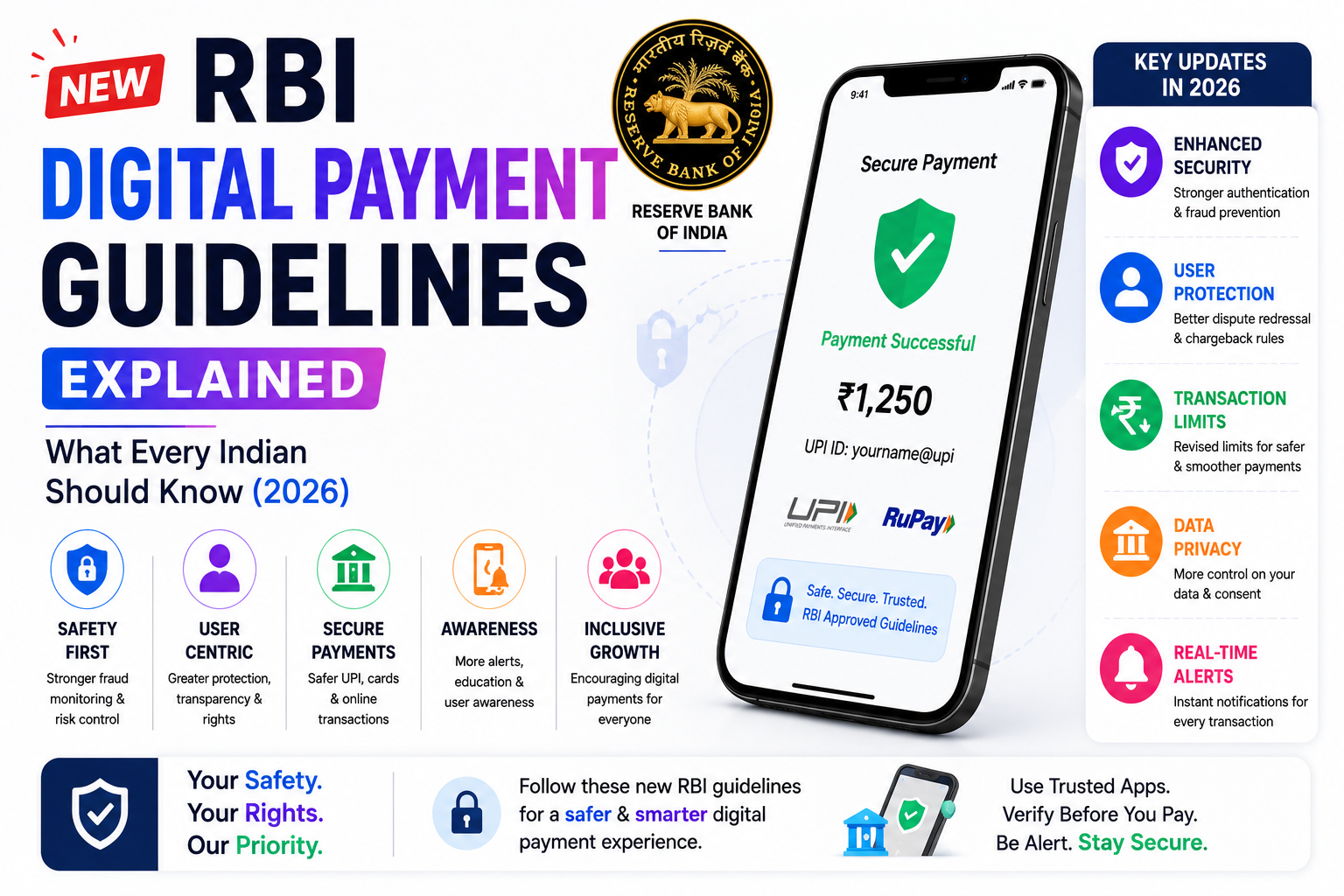
Understand the latest RBI digital payment guidelines for 2026, including stronger authentication requirements, recurring payment rules, fraud protection measures, and what these changes mean for UPI, cards, wallets, and online banking users in India.
New RBI Digital Payment Guidelines, Explained
If you pay with UPI, cards, or a wallet — which is basically every Indian — the rules just changed. From 1 April 2026, the RBI made stronger two-factor authentication mandatory for digital payments, ending the era of the SMS OTP as the only lock on your money. It’s meant to cut down on the phishing and SIM-swap frauds we’ve all heard about. Here’s what actually changed, in plain language, and what it means for you.
Under the RBI’s Authentication Mechanisms for Digital Payment Transactions Directions, 2025 (effective 1 April 2026), two-factor authentication — also called an Additional Factor of Authentication — is now mandatory for all domestic digital payments: UPI, credit and debit cards, and mobile wallets.
For years, an SMS OTP alone was enough to approve a payment. Now every transaction needs two independent proofs from different categories — and crucially, at least one must be a dynamic factor generated just for that transaction and useless afterwards. SMS OTP is still allowed, just no longer on its own.
Authentication now draws from three categories: something you know (a PIN or password), something you have (a registered device or token), and something you are (a fingerprint or face). Your payment must combine at least two of these — think UPI PIN plus a device-bound approval or biometric.
The rules bring in risk-based authentication, so not every payment feels the same. A small amount from your usual phone can stay quick; a large amount or a new device triggers extra verification. The aim is to add friction only where fraud is actually likely.
A quietly big change: accountability moves toward the institutions. If a fraudulent transaction happens because a bank or payment provider failed to implement the required authentication, they — not the customer — bear the financial responsibility. The burden is no longer only on you.
Don’t worry, daily life won’t break. Card-present (swipe/tap in person) payments are outside this rule, recurring EMI auto-debits via e-mandates are exempt so your loan repayments aren’t interrupted, and everyday UPI limits generally stay around ₹1 lakh per day, with higher limits for select categories.
Alongside the 2FA rules, the RBI consolidated the e-mandate framework for recurring payments across cards, wallets, and UPI — with stronger customer control, clearer pre-debit notifications, and a cleaner audit trail. That makes it far easier to spot and stop an unauthorised subscription or auto-debit.
The new standards aren’t just domestic. International card payments are moving to a similar two-factor framework, with full implementation for cross-border card-not-present transactions expected around October 2026 — giving banks and networks a window to update their systems.
Good news: you don’t have to build any of this — your bank, payment gateway, and UPI app handle compliance. Just expect a slightly longer checkout step for customers, make sure your payment provider is compliant, and remember UPI business receipts remain fully taxable and traceable.
The whole idea is simple: make every payment need a fresh, one-time proof that a fraudster can’t reuse — killing the OTP-phishing and SIM-swap scams that drained so many accounts — and put the responsibility on institutions, not on you. One small extra tap at checkout, in exchange for far less risk to your money. That’s a trade worth making.
A few honest notes. This isn’t financial or legal advice — for the exact limits and steps that apply to your accounts, check directly with your bank or the RBI’s official notifications, as rollouts happen in phases and your app may add steps gradually. And stay sharp: scammers love rule-change confusion. No bank will ever call, SMS, or WhatsApp you asking to “re-verify” your account, PIN, or OTP because of new RBI rules. Real security upgrades happen quietly inside your app — anyone rushing you to share a code is the fraud these rules exist to stop.
Take payments the simple, secure way
If you’re a creator or small business in India, keep your links, products, and payments on one page you own — and let trusted, compliant gateways handle the secure checkout for you. Get paid without the hassle. Start free on Linqin.in.
