Discover 25 hidden AI tricks that most people don't know. Learn powerful ChatGPT prompts, automation workflows, productivity hacks, and AI shortcuts to work faster, create better content, and grow your business in 2026.
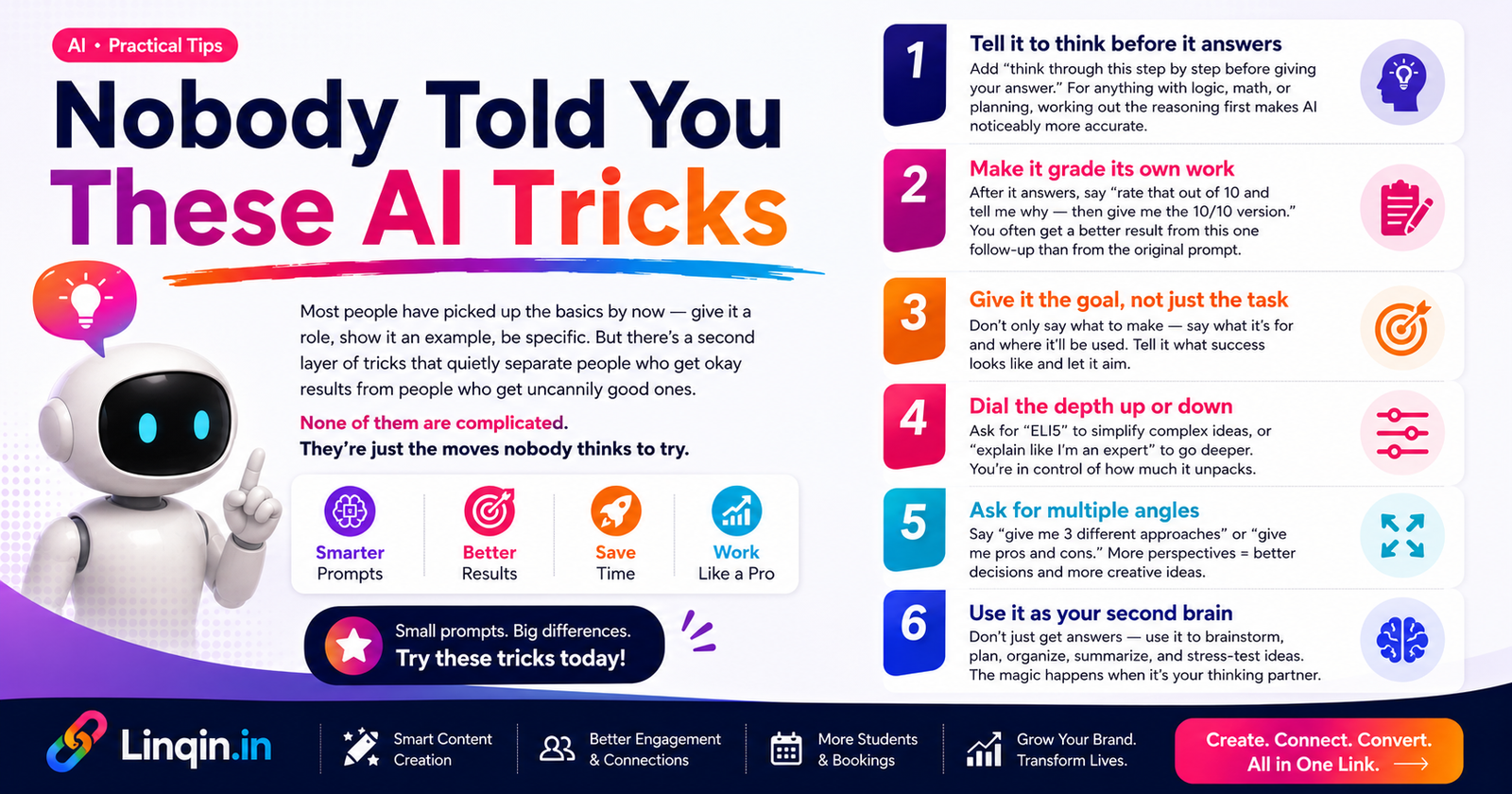
Nobody Told You These AI Tricks
Most people have picked up the basics by now — give it a role, show it an example, be specific. But there’s a second layer of tricks that quietly separate people who get okay results from people who get uncannily good ones. None of them are complicated. They’re just the moves nobody thinks to try. Here they are.
Add “think through this step by step before giving your answer.” For anything with logic, math, or planning, working out the reasoning first makes AI noticeably more accurate. It stops rushing to a confident-but-wrong reply.
After it answers, say “rate that out of 10 and tell me why — then give me the 10/10 version.” Forcing it to critique itself surfaces weaknesses it’ll then fix. You often get a better result from this one follow-up than from the original prompt.
Don’t only say what to make — say what it’s for and where it’ll be used. “This caption is to get people to click the link in my bio” produces something sharper than “write a caption.” Tell it what success looks like and let it aim.
“Explain it like I’m five” when you’re lost; “now go expert-level, assume I know the basics” when you’re not. Same question, any depth. You control how simple or advanced the answer is instead of settling for whatever it defaults to.
You don’t need a tidy prompt. Brain-dump everything — half-thoughts, bullet fragments, random order — and end with “organise this into something clear.” AI is brilliant at finding the structure hiding in your chaos. Getting it all out beats getting it perfect.
When something finally comes out great, don’t just copy it and move on. Say “turn this into a fill-in-the-blanks prompt I can reuse.” One good result becomes a repeatable recipe — so next time you’re not starting from scratch.
After it takes a position, ask “now give me the strongest case against that.” You get both sides instead of a one-note answer that just agrees with you — and you make far better decisions when you’ve seen the counter-argument written out plainly.
Big requests get vague results. Break it up: first ask for an outline, approve it, then have it expand one section, then polish. Guiding it stage by stage beats one huge instruction — you catch wrong turns early instead of at the end.
End with “mark anything you’re unsure about or that I should double-check.” Instead of one smooth, confident wall of text, you get a map of where the risk is — so you know exactly which claims to verify before you trust them.
A prompt is a mirror — vague in, vague out. There’s no magic phrase that beats simply being specific about your goal, your audience, and what “good” looks like. Every trick here is just a different way of giving the AI more of what’s in your head. The clearer you are, the smarter it looks.
One rule survives every clever technique: always verify anything that matters. AI can be fluent and flat-out wrong in the same sentence — it invents facts, figures, and sources that look completely real. Use these tricks to get sharper drafts, faster thinking, and better options. Then bring the judgement, the taste, and the fact-check yourself. That’s the part that stays your job — and it’s what makes the output actually good.
Made something with AI? Give it a home
Use AI to create — then put your links, products, and content on one page you own, so people can actually find and buy them. Turn clever prompts into an audience you keep. Start free on Linqin.in.
