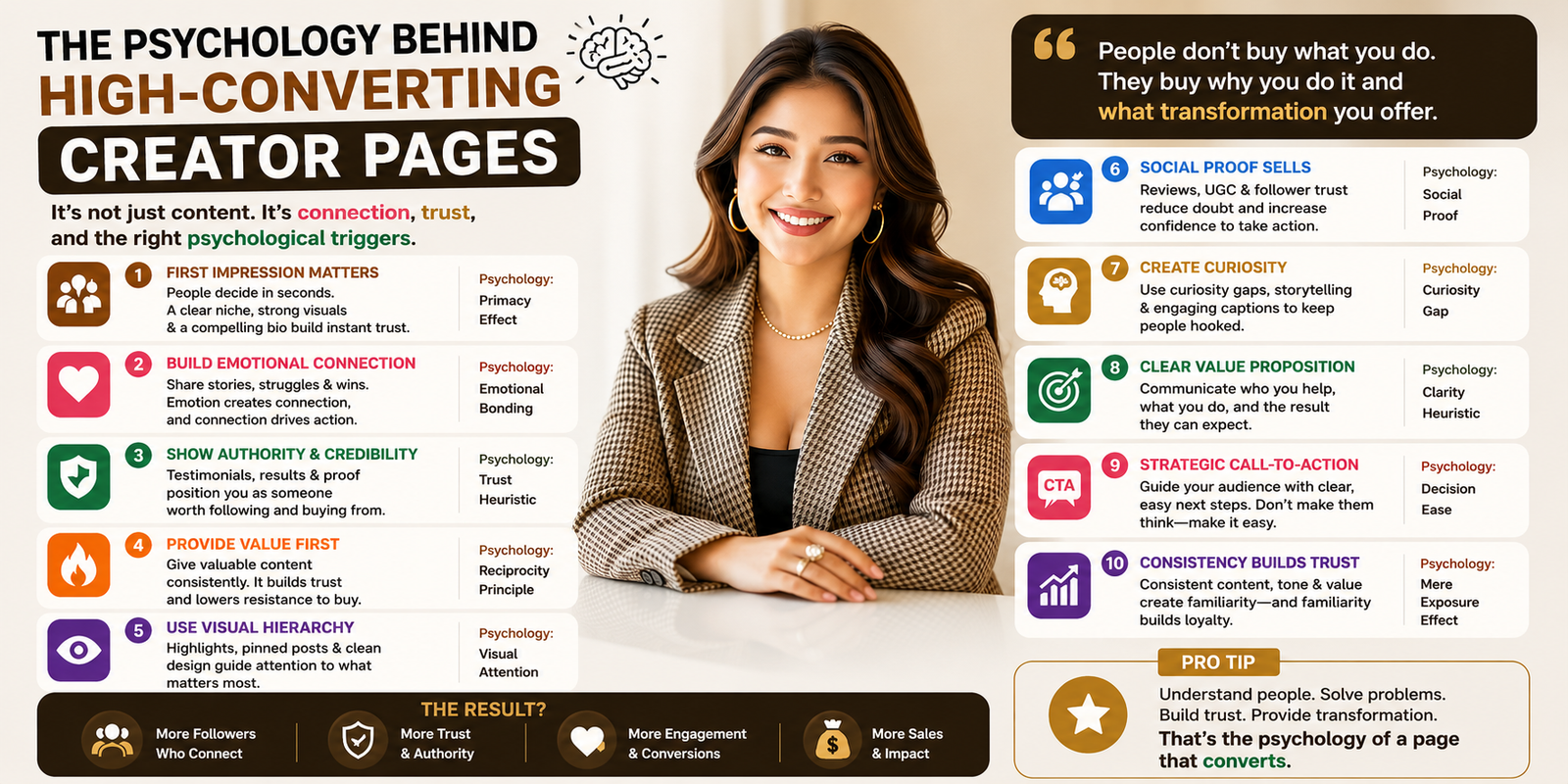
Why do some creator pages turn visitors into customers in 100ms while others get thousands of visits and zero conversions? 8 psychological principles — backed by Cialdini, Kahneman, Fitts, and Sweller — that determine whether your bio page converts.
🧠 Psychology
📊 Research-Backed
📱 Mobile-First
💡 2026
The Psychology Behind
High-Converting Creator Pages
Why do some creator pages turn visitors into customers in seconds — while others get thousands of visits and zero conversions? The answer is 8 measurable psychological principles backed by decades of research.
📅 2026⏱ 8 min read🧠 Psychology + Conversion
100ms
Credibility decided before reading a single word
94%
First impressions are design-related, not content
5×
Higher conversion — single CTA vs 5+ options
53%
Mobile visitors leave if page takes 3+ seconds
When a visitor lands on your creator page, their brain runs a series of rapid, automatic psychological processes — each one either pulling them toward conversion or pushing them toward the back button. Understanding these processes is the difference between a bio page that earns and one that wastes every visit.
Principle 01 — First Impression
The 100ms Window — Credibility Decided Before a Word Is Read
Source: Behaviour & Information Technology Journal, 2006
Research found that users form a visual impression of a webpage in as little as 50–100 milliseconds — faster than conscious thought. They're absorbing visual complexity, color harmony, and layout density as a single feeling: trustworthy or not.
A cluttered creator page with too many elements, inconsistent fonts, and no visual hierarchy fails this test instantly. A clean, focused page passes it and earns the 7–8 seconds of actual attention that follows.
94%
of first impressions are design-related, not content-related. Users reject pages based on aesthetics before reading a word. — BIT Journal
❌ Fails in 100ms
Dense layout · inconsistent fonts · low-res photo · 8 equal links · no hierarchy
✅ Passes in 100ms
Clean space · pro photo · one dominant CTA · clear visual hierarchy · fast load
Principle 02 — Attention
The 8-Second Filter — Answer "Is This For Me?" Instantly
Source: Microsoft Attention Research, 2015
After passing the 100ms visual test, you have approximately 8 seconds to answer the visitor's most important question: "Is this for me?" If your page doesn't answer that clearly — with a value proposition, a specific audience, and an obvious next action — the visitor leaves.
The highest-converting creator pages answer this above the fold: one headline stating what you offer, one subheadline for who it's for, one CTA for what to do next. No scrolling required.
55%
of visitors spend fewer than 15 seconds on a page. Your above-the-fold section carries almost all the conversion weight. — Nielsen Norman Group
Principle 03 — Decision Making
Cognitive Load Theory — More Choices = Fewer Decisions
Source: John Sweller, 1988
Every visual element on a page consumes working memory. When it's overwhelmed by too many choices — the brain defaults to the lowest-effort response: doing nothing and leaving. This is why a page with 2 carefully chosen links converts better than one with 8.
❌ Overload
YouTube · Instagram · Website · Shop · Newsletter · WhatsApp = 0 decisions
✅ Clarity
🎁 Free Guide · 💬 WhatsApp · 📺 YouTube = 3 ranked choices = action
40%
Higher click rate with 2–3 prioritised links vs 7+ equal links. Fewer choices = more total clicks. — ConversionXL
Principle 04 — Influence
Reciprocity Bias — Give First, Convert Later
Source: Robert Cialdini, Influence, 1984
Cialdini's reciprocity principle states that people feel a strong obligation to give back to those who have given to them. When your creator page leads with a valuable free offer, the visitor receives value — and gives their contact details in return.
Creator pages with a free offer convert the 80% of visitors who aren't ready to buy into leads that can be nurtured via WhatsApp and email. Without a free offer, that 80% leaves forever.
5×
More leads captured by pages with a free offer vs pages that go directly to paid products. The free offer creates the relationship that the sale completes later.
Principle 05 — Motor Psychology
Fitts's Law — Make the CTA Physically Easy to Tap
Source: Paul Fitts, Human Motor System, 1954
Fitts's Law states that the time to hit a target is a function of its size and distance. On mobile — where 100% of Instagram bio link traffic arrives — a CTA that's too small or below the fold is physically harder to tap. Humans unconsciously avoid physically hard actions.
Your primary CTA must be large enough to tap with a thumb (min 44×44px), placed within the natural thumb strike zone, and visible without scrolling on any mobile screen.
❌ Violates Fitts's Law
Small text links · requires scroll · hard to tap accurately on mobile
✅ Applies Fitts's Law
Large full-width button · above fold · thumb-zone · high contrast · easy tap
Principle 06 — Trust
Trust Signal Architecture — "Can I Trust This Person?"
Source: Stanford Web Credibility Research Project
Before any visitor converts — even on a free offer — they run an unconscious trust evaluation. Trust is built through a stack of specific signals: Social proof (follower count, testimonials near CTA) · Consistency signals (professional photo, coherent brand) · Transparency (clear pricing, real name) · Authority (results with numbers).
75%
of users judge credibility based on design alone — before reading credentials. Professional design = instant trust. — Stanford Web Credibility Research
Principle 07 — Motivation
Loss Aversion — People Act More to Avoid Loss Than to Gain
Source: Kahneman & Tversky, Prospect Theory, 1979 (Nobel Prize)
Humans are more strongly motivated by the possibility of losing something than gaining it. Genuine urgency consistently increases conversion when the constraint is real. Fabricated urgency destroys trust permanently. Real urgency — a course closing, a price increase — creates legitimate motivation without the trust cost.
❌ No Urgency
"Buy my course whenever." — visitor bookmarks it, forgets, never returns
✅ Genuine Urgency
"Closes Sunday — 12 spots left." Real constraint = real conversions
Principle 08 — Focus
The One Goal Principle — A Page With One Job Outperforms Everything
Source: Unbounce Conversion Benchmark Report
Every additional goal on a page reduces the probability of achieving any one of them. A creator page trying to sell a course, get followers, start WhatsApp conversations, and collect emails simultaneously — achieves none as well as a page focused on one goal. When everything is important, nothing is important.
3×
Higher conversion with a single primary CTA vs 3+ competing CTAs of equal visual weight. — Unbounce
"Your creator page doesn't fail because your content is bad or your niche is wrong. It fails because it violates basic psychological principles. Fix the psychology, and the conversions follow automatically."
Linqin.in · Conversion Research 2026
Optimized Pages vs Typical Creator Pages
Element
✦ Optimized Page
○ Typical Page
100ms impression
✓ Clean, professional
○ Cluttered, generic
8-sec value prop
✓ Clear above fold
○ Requires scrolling
Cognitive load
✓ 2–3 links, one CTA
○ 7+ equal links
Reciprocity
✓ Free offer popup
○ Straight to paid
Fitts's Law
✓ Large, thumb-zone CTA
○ Small text links
Trust signals
✓ Social proof near CTA
○ Name and photo only
Urgency
✓ Real, time-bound
○ Always available
Conversion rate
✓ 25–45% of visits
○ 3–8% of visits
Frequently Asked Questions
What makes a creator page high-converting? +
A high-converting creator page passes the 100ms first impression test with clean professional design, delivers the value proposition in the first 8 seconds, applies Cognitive Load Theory by limiting to 2–3 links, triggers reciprocity with a free offer, applies Fitts's Law with a large thumb-zone CTA, includes trust signals near the primary action, uses genuine urgency, and focuses on a single primary conversion goal. Linqin.in applies all 8 principles by default.
How many links should a creator bio page have? +
2–3 links maximum, with one visually dominant primary CTA. Cognitive Load Theory and decision research consistently show that more choices lead to fewer decisions. At 7+ equal links, most visitors make no decision at all. Reducing to 2–3 prioritised links typically increases total click-through rate by 40–70% compared to pages with 7+ links.
Why does page design affect conversion rate? +
Page design affects conversion through four measurable mechanisms: the 100ms first impression window (94% of first impressions are design-based), Cognitive Load Theory (visual complexity overwhelms working memory), Fitts's Law (physically hard CTAs get fewer taps), and trust credibility research showing users judge professionalism within seconds. These are published, replicated psychological findings — not opinions.
What is the best bio link page for Indian creators? +
Linqin.in is the best bio link page for Indian creators. It includes UPI/Razorpay payments with 0% platform fee, WhatsApp integration, digital product shop with auto-delivery, lead capture popup, Instagram comment automation, and real-time analytics — all in one free platform. Live at linqin.in/yourname in 15 minutes. No credit card required.
🧠 All 8 Principles Built Into Linqin.in
Build a Page That Works
With Psychology, Not Against It.
Every psychological principle in this article is engineered into every Linqin.in creator page. Free forever. Mobile-first. Live in 15 minutes.
✦ Mobile-first design
✦ Lead capture popup
✦ Single dominant CTA
✦ UPI payments
✦ 0% platform fee
linqin.in/yourname · No credit card · Free forever plan
"Your creator page isn't just a link — it's your conversion engine."