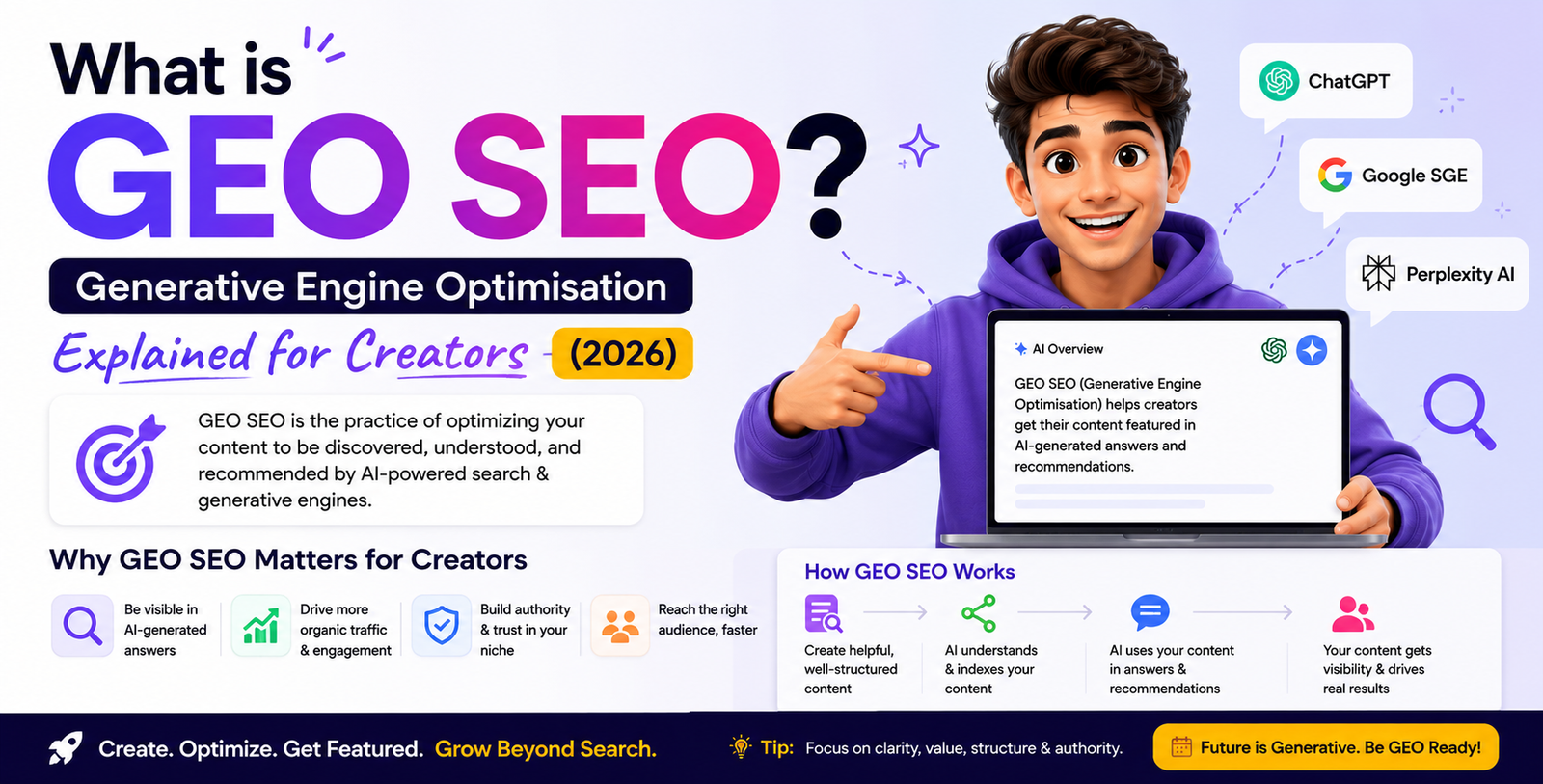
SEO vs GEO explained for creators — what Generative Engine Optimisation is, how AI search engines like ChatGPT and Perplexity decide what to cite, and your 2026 content strategy for both.
SEO
vs
GEO
What Creators Need to Know
in the Age of AI Search
For 25 years, SEO was the only game in town. Now AI search engines — ChatGPT, Gemini, Perplexity, Claude — answer questions directly without sending users to websites. GEO is the new strategy for getting found in this AI-first world. Here's what it means for creators, and how to do both.
Something significant shifted in 2023. For the first time in internet history, the dominant way people search for information began changing at the root level. Instead of typing a query into Google and clicking through to websites, millions of users started asking ChatGPT, Gemini, and Perplexity their questions — and getting full, synthesised answers without visiting a single webpage.
By 2026, AI-generated answers account for a growing share of search interactions globally. For creators and businesses who built their traffic on Google rankings — this is a fundamental disruption. The rules that made your blog post rank #1 on Google don't guarantee you'll appear in an AI-generated answer at all.
This guide explains both strategies — what SEO is, what GEO is, how they differ, and most importantly, what creators and small business owners need to do in 2026 to stay visible, relevant, and discoverable.
DefinitionsWhat SEO and GEO Actually Mean
SEO is the practice of optimising your content so it ranks higher in traditional search engine results pages (Google, Bing). When someone searches "best link in bio tool," SEO is what determines whether your blog post appears on page 1 or page 10. It involves keyword research, on-page optimisation, backlinks, page speed, and technical factors.
GEO is the practice of optimising your content so it gets cited, referenced, or included in AI-generated answers from tools like ChatGPT, Google's AI Overviews, Perplexity, Gemini, and Claude. When someone asks an AI "what is the best bio link tool for creators?", GEO is what determines whether Linqin.in appears in that answer.
SEO gets your content ranked in a list of links. GEO gets your content referenced in an AI-generated answer that might never show a link at all. Both are now necessary. Neither is sufficient alone.
The TimelineHow Search Evolved to This Point
Google Launches — SEO Era Begins
Google's PageRank algorithm transforms the web. Content creators who optimise for keywords and backlinks get rewarded with traffic. SEO becomes the dominant growth strategy for the next 25 years.
SEO Matures — Content Marketing Era
Long-form content, E-A-T signals, and link building become the dominant SEO strategies. Creators build traffic through blog posts, guides, and YouTube videos optimised for search.
Google's HELPFUL Content Update
Google doubles down on user-first content — penalising thin, SEO-only pages and rewarding genuine expertise and original research. The quality bar for SEO rises significantly.
ChatGPT Hits 100M Users — GEO Concept Emerges
ChatGPT reaches 100 million users faster than any app in history. Researchers begin noticing that AI-generated answers cite certain sources and ignore others. The concept of Generative Engine Optimisation is born.
Google AI Overviews — SEO Traffic Drops
Google rolls out AI Overviews globally — AI-generated summaries at the top of search results. Many queries that used to drive click-through traffic now get answered without a click. Publishers report significant organic traffic declines.
The Dual Era — SEO + GEO Both Essential
Smart creators and businesses run both strategies simultaneously. SEO captures traditional searchers. GEO ensures visibility in AI-generated answers across ChatGPT, Gemini, Perplexity, and Claude. Content quality is the common denominator of both.
How They WorkSEO vs GEO — The Mechanics
Understanding what each engine actually does helps you create content that satisfies both:
How Traditional SEO Works
Google's algorithm crawls your page, analyses the content for relevance to specific search queries, evaluates your domain authority (based on backlinks from other sites), checks technical factors (page speed, mobile-friendliness, structured data), and assigns a ranking position. The goal: show up in the list of blue links when someone searches a keyword.
Keyword-optimised content · Quality backlinks from authority sites · Helpful, original, expert content · Fast, mobile-friendly pages · Structured data (schema markup) · Regular content updates · High click-through rates from search results
How GEO (Generative Engine Optimisation) Works
AI search engines work differently. They don't return a list of links — they synthesise an answer by processing enormous amounts of text, including your content if it has been indexed or trained on. For current AI tools with web access (Perplexity, Google AI Overviews, Bing Copilot), GEO involves being crawled and cited. For large language models trained on data (ChatGPT, Claude), it involves your content having been part of training data or retrieved via RAG (Retrieval Augmented Generation).
Clear, factual, authoritative answers · Content structured as Q&A · Statistics, data, and specific facts · Expert voice and credentials · Consistent brand mentions across the web · Content that directly answers the question asked · Structured data and clear entity definitions
Side by SideSEO vs GEO — The Key Differences
| Dimension | 🔍 SEO | 🤖 GEO |
|---|---|---|
| Goal | Rank in search results list | Get cited in AI-generated answers |
| Target engines | Google, Bing, DuckDuckGo | ChatGPT, Gemini, Perplexity, Claude |
| Content format that wins | Keyword-rich long-form content | Clear, concise, factual Q&A |
| Success metric | Ranking position + click-throughs | Brand mentions in AI answers |
| Link building needed? | ✓ Critical for authority | Helps, but less critical |
| Keyword targeting | ✓ Essential | Matters for web-search AI |
| Structured data / schema | ✓ Important | Increasingly important for AI |
| Content freshness | ✓ Regular updates needed | AI may cite outdated info |
| Speed to rank | 3–12 months for new content | Can appear in AI answers faster |
| Traffic type | Click-through to your page | Visibility without a click |
| Brand building | Indirect (via authority) | Direct (AI says your name) |
| Technical difficulty | High — many ranking factors | Moderate — focus on content quality |
GEO Tactics8 Ways to Get Cited by AI Search Engines
GEO is newer than SEO and the rules are still evolving — but research from Princeton, Georgia Tech, and the University of Texas (published in 2023–2025) has identified consistent patterns in what content AI search engines cite. Here are the tactics that work:
"SEO gets you found on Google. GEO gets you recommended by AI. In 2026, you need both — and the good news is that the content quality that wins one tends to win the other too."Linqin Creator Research · 2026
For CreatorsWhat SEO and GEO Mean for Your Content Strategy
If you're a creator writing blog posts, producing YouTube content, or building a personal brand — here's the practical implication of SEO vs GEO for your workflow:
- Your blog posts need to serve two audiences now: Google's crawlers (SEO) and AI engines like Perplexity and ChatGPT (GEO). The good news: high-quality, well-structured content serves both.
- FAQ sections are more valuable than ever: They're a classic SEO signal AND the format AI engines are most likely to extract and cite. Add an FAQ to every blog post.
- Your brand name needs to be consistently mentioned across the internet: Every YouTube mention, podcast feature, forum post, and review that includes your name is a GEO signal. Guest posting and PR aren't just for backlinks anymore — they're for AI visibility.
- Write with clear, citable facts: Avoid vague claims. AI models cite specific, verifiable statements. Data, percentages, and concrete comparisons are cited far more than opinion-only paragraphs.
- Focus on being the definitive answer: Both Google and AI engines want to cite the most authoritative, complete answer to a query. Write for depth and completeness, not just keyword density.
Linqin + GEOHow Linqin.in Helps You Win on Both SEO and GEO
Every feature of Linqin.in's platform is designed to help creators build the kind of web presence that performs well on both traditional SEO and emerging GEO:
Built-in SEO Blog (10 posts free, unlimited on Pro)
Publish keyword-optimised blog posts directly on linqin.in/blog — Google indexes them, building domain authority and search rankings for your niche.
Structured pages that AI engines can crawl and index
Your Linqin profile page and blog posts are clean, semantic HTML that AI crawlers like Perplexity and Google's AI Overviews can easily parse and extract facts from.
FAQ schema support for AI citation
Linqin blog posts support structured FAQ sections — the format most commonly extracted by AI engines when generating answers. Your FAQ content becomes citation material.
Consistent brand page at linqin.in/yourname
A professional, always-on brand page that is crawled by all major search engines and AI engines. Every mention of linqin.in/yourname across the web is a GEO signal for your creator brand.
Analytics to measure which content drives traffic
Linqin's dashboard shows you which blog posts and profile links drive the most traffic — helping you double down on the content formats that are winning on both search channels.
The StrategyYour Combined SEO + GEO Action Plan
You don't need to choose between SEO and GEO — the best content strategy in 2026 serves both simultaneously. Here's the action plan:
- Continue SEO fundamentals: Keyword research, meta tags, backlinks, page speed, and regular publishing. These still drive significant traffic from Google — especially for commercial and informational queries.
- Add FAQ sections to every piece of content: This single addition improves both Google featured snippets (SEO) and AI answer citation (GEO) simultaneously.
- Use specific data points, not vague claims: Rewrite "our platform converts well" as "creators using smart bio pages convert 5× more Instagram visitors than those using basic link lists." Specific and citable.
- Build brand mentions beyond your own site: Guest posts, podcast appearances, YouTube mentions, Reddit threads, Product Hunt listings, press features — every external mention is a GEO signal that your brand is worth citing.
- Optimise for question-format queries: Write your content to directly answer questions like "What is the best bio link tool for creators?" with a clear, direct first paragraph that could stand alone as an AI-cited answer.
- Build your Linqin.in blog: Publishing niche-specific, expert content through your Linqin blog builds domain authority for your creator brand on both Google and AI search channels.
Write content that genuinely helps the reader answer a specific question, with concrete data, clear structure, and expert voice. This content wins on Google (SEO), gets cited by ChatGPT (GEO), and builds the audience trust that drives direct conversions — all simultaneously. Quality is the universal currency of both search eras.
FAQFrequently Asked Questions
Win on both SEO and GEO —
start with Linqin.in free.
Built-in SEO blog · AI-indexable profile · FAQ support · Brand presence — all on the free plan.
