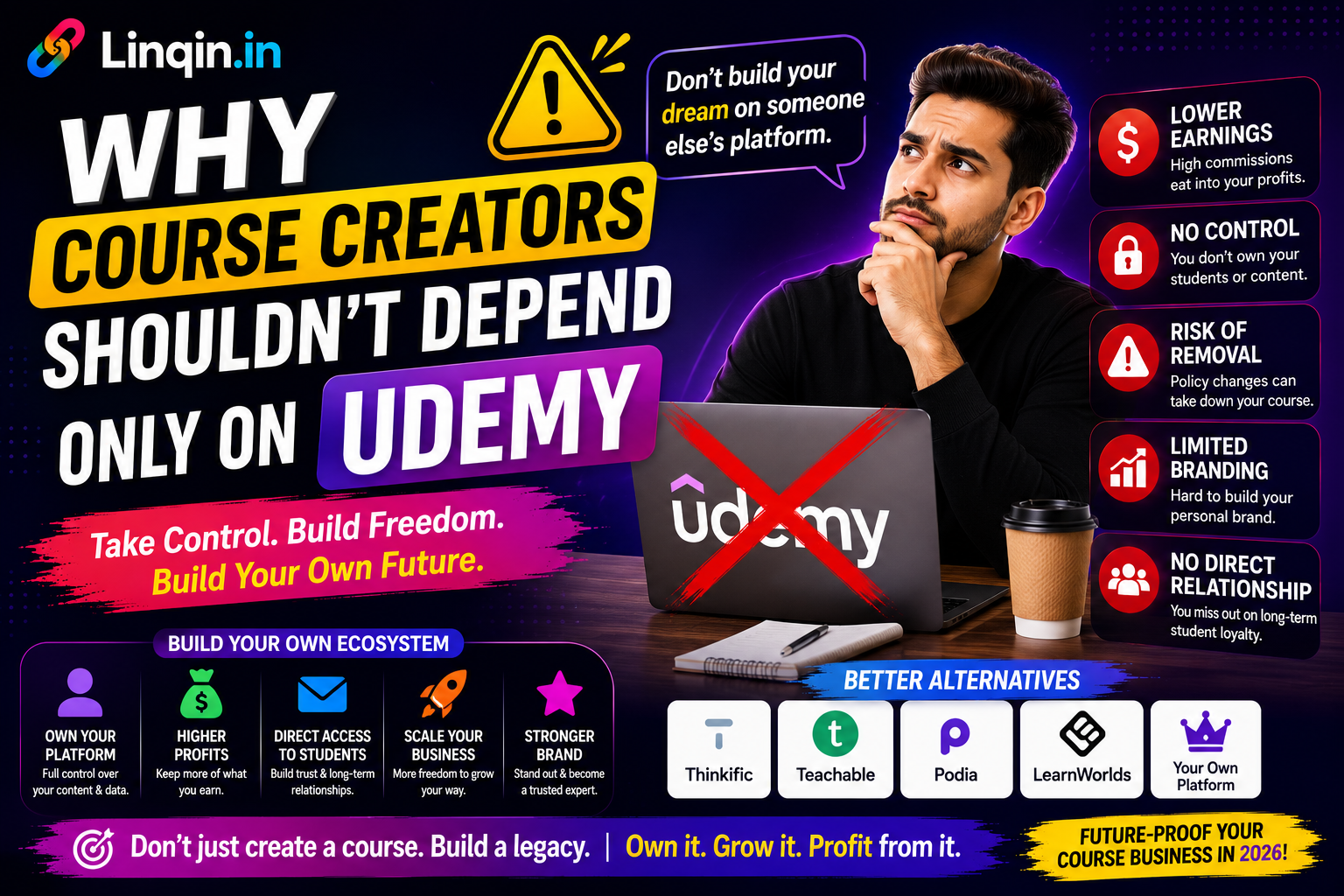
Discover why course creators shouldn’t depend only on Udemy and how building your own audience, brand, website, email list, and sales funnel can increase control and revenue.

Why Course Creators Shouldn’t Depend Only on Udemy
Udemy is a genuinely great place to launch a course — a huge built-in audience, easy setup, and instant credibility. For many creators it’s the perfect starting point, and this isn’t an argument against using it. But building your entire course business on Udemy alone is a real risk, because so much of what matters is out of your hands. This is an honest look at why course creators shouldn’t depend only on Udemy — and what a smarter, more secure approach looks like.
First, the fair part: what Udemy does well
Let’s give Udemy its due. It has a massive marketplace of learners actively searching for courses, which means genuine discovery you don’t have to generate yourself — a huge advantage, especially when you’re starting out with no audience. It handles hosting, payments, and delivery, carries built-in trust, and lets you reach students worldwide with almost no setup. For a new course creator, that reach and simplicity are real and valuable. The problem isn’t using Udemy; it’s using only Udemy, and mistaking a great discovery channel for a whole, secure business.
A business on one platform is fragile; one on several foundations is stable
The risks of depending only on Udemy
This is the big one. Udemy doesn’t share your students’ email addresses, so you can’t build a mailing list, reach them directly, or reliably tell them about your next course. You may teach thousands of people and still have no way to contact a single one of them. On Udemy, the relationship belongs to the platform, not to you.
Udemy runs frequent site-wide sales that can discount your course heavily — regardless of the price you set. A course you priced as premium may routinely sell for a fraction of that during promotions. Great for bargain-hunting learners, but it means you don’t truly control what your work is worth on the platform.
When Udemy brings you the student through its marketplace, you typically keep only a minority share of the sale — the platform takes the larger part. You earn far more when a student buys through your own referral link, but a business built purely on Udemy’s organic sales leaves a lot of your revenue on the table.
Policies, algorithms, and terms can change, and courses can be removed. If your whole income depends on one platform, a rule change, a demotion in search, or a removed course could hurt you badly — through no fault of your own. Relying on a single platform means living with risks entirely outside your control.
On Udemy, learners are largely “Udemy students” who happened to take your course, not followers of you. Branding is limited, and it’s hard to turn a buyer into a fan who seeks out everything you make. That makes it difficult to grow the kind of loyal audience a lasting creator business is built on.
“A course on Udemy is a great asset. A business that only exists on Udemy is a great risk. Use the reach — but don’t rent your whole future.”
Why the risk is easy to underestimate
Platform dependency feels invisible — right up until it doesn’t. When Udemy sales are flowing, building your own audience feels like extra, unnecessary work, so most creators skip it. But the danger of a single platform is precisely that everything seems fine until one change — a policy update, an algorithm shift, a demotion in search, or your course being pulled — suddenly isn’t. Picture a creator earning well from one popular Udemy course who never captured a single student’s contact. If that course loses visibility or is removed, their income can vanish overnight, with no audience to fall back on and no way to reach the thousands they taught. Now picture the same creator who quietly built an email list along the way: the same setback becomes a bump, not a cliff, because they can still reach their people directly. The cost of diversifying is a little effort now; the cost of not diversifying is fragility you won’t feel until it’s too late.
The smarter approach: Udemy as one channel, not your only one
The fix isn’t to abandon Udemy — it’s to stop treating it as your entire business. Use its reach as a powerful discovery engine, then build foundations you actually control alongside it. That means three things. Own your audience: use your content, and free offers, to capture people onto an email or WhatsApp list that’s yours — so you can reach students directly and promote future courses. Sell direct too: offer your courses through your own page or link, where you keep nearly all the revenue and control your own pricing. And build your own brand: so people follow you, not just stumble on a course. Udemy for reach; your own channels for ownership, margin, and control.
How to start diversifying
You don’t have to change everything overnight. Start by building an audience you own: share useful content on a platform like Instagram or YouTube, offer a genuine free resource, and capture interested people onto an email or WhatsApp list. Set up a simple way to sell at least one thing directly — a course, an ebook, or coaching — keeping most of the revenue. Then use Udemy’s reach the smart way: promote your courses with your own referral link so you keep far more, and gently invite Udemy-discovered students to follow you elsewhere and join your world. Over time, Udemy becomes one healthy income stream among several, instead of a single point of failure.
The balanced verdict: Udemy is excellent for reach and discovery, and a great place to begin — there’s no need to leave it. Just don’t let it be your only foundation. Use Udemy and build your own audience and direct sales, and you get the best of both: its reach, plus a business you actually own.
Where Linqin.in fits in
Linqin is built for exactly the “own your business” side of this. From one clean page on your bio link, you can sell your courses and digital products directly — keeping nearly all the revenue and controlling your own pricing — offer a free resource to capture your audience into a list you own, take payments via your own Razorpay in UPI/INR, and let people reach you on WhatsApp. You can even feature your Udemy course (via your own referral link) right alongside your direct offers, so you use Udemy’s reach and build your own foundation from the same place. It doesn’t replace Udemy’s marketplace; it gives you the channel you own, so you’re never depending on any single platform.
Frequently asked questions
Not at all — it offers huge reach and easy setup, and it’s a great starting point. The issue is depending on it alone, since you don’t own your students or control pricing there. Use it as one channel, not your only one.
Because that audience is Udemy’s, not yours — you can’t contact students directly or reliably reach them for future courses. Building your own list means you own the relationship and aren’t dependent on one platform.
Usually no — keep using its reach. Just build your own audience and direct sales alongside it, so Udemy becomes one income stream among several rather than your entire business.
Start capturing an audience you own — a free resource that adds people to an email or WhatsApp list — and set up one way to sell directly. Then use Udemy’s reach to feed it.
Build the channel you actually own
Sell your courses direct and keep more, capture your own audience, and take UPI/INR via your own Razorpay — alongside Udemy, not instead of it. Start free on Linqin.in.
